A metal building kit costs less per square foot than stick framing, but the kit price and the finished price are two different numbers. The kit is the steel shell that ships to your site. The finished building also carries a foundation, a permit, delivery, doors, and any insulation or interior work. As an illustrative 2026 figure, common shells run from the high four figures for a small garage to the low six figures for a wide commercial span ‹confirm›, before any of those other lines.
That gap between the sticker and the finished cost is where most budgets go wrong. A quote that reads “$20k building” rarely stands complete for $20k, because the headline almost always describes the shell alone. Read every quote for what it includes before you compare two totals, and treat any single number as a starting point, not a promise.
This guide is the hub for our Prices & Cost library. It covers what a kit costs and why, the price per square foot by size, what drives a quote up or down, the difference between a shell and an installed building, the hidden costs people miss, financing and payment options, and the honest ways to spend less. Every dollar figure here is a dated 2026 illustrative range flagged for you to verify against a current quote. Start with the full cost breakdown or the prices by size chart.
01 / The Honest Number
How much do metal building kits cost?
A metal building kit costs roughly what its steel weighs, plus engineering and freight, so the price tracks size, gauge, and the steel market more than anything else. The number you see advertised is almost always the shell: the frame, panels, fasteners, trim, and a stamped drawing set. The number you spend to stand a finished building is higher, because the slab, permit, doors, and delivery sit outside that figure.
Splitting the cost into two buckets keeps a budget honest. The first bucket is the kit. The second is everything that turns a pile of steel into a building you can use. Here is the split, with illustrative 2026 ranges you should confirm against a live quote:
| Bucket | What it covers | Share of a typical finished cost |
|---|---|---|
| The kit (shell) | Frame, roof and wall panels, fasteners, trim, stamped drawings | Often 50 to 70 percent ‹confirm› |
| Foundation | Slab or piers, anchor bolts, site grading | Often 15 to 30 percent ‹confirm› |
| Openings & finish | Doors, windows, insulation, interior work | Varies widely by use ‹confirm› |
| Permit, delivery, labor | Permit fees, freight, and erection if not DIY | Often 10 to 25 percent ‹confirm› |
Illustrative shares for 2026, not fixed rules. The split shifts with how much you finish and whether you build it yourself.
Shell price vs turnkey price
A “shell” or “kit” price is the steel only. A “turnkey” price is the finished, installed building. When two suppliers quote the same footprint and one number is far lower, the cheaper one is usually a shell and the other is closer to turnkey. Our full breakdown guide separates every line so you can tell which number you are reading.
02 / Per Square Foot
Metal building cost per square foot
Cost per square foot is the fairest way to compare buildings of different sizes, and for a metal building shell it usually falls as the building gets bigger, because the frame and engineering spread across more floor area. As an illustrative 2026 range, a bare shell often lands somewhere between a low and a mid double-digit dollar figure per square foot ‹confirm›, while a finished, insulated building with a slab runs well above that.
| Size band | Shell $/sq ft (2026, illustrative) | Finished $/sq ft (2026, illustrative) | Why it lands here |
|---|---|---|---|
| Small (under 1,200 sq ft) | $12–$22 ‹confirm› | $25–$45 ‹confirm› | Fixed engineering spreads over little area |
| Mid (1,200 to 3,000 sq ft) | $10–$18 ‹confirm› | $22–$40 ‹confirm› | The value sweet spot for shops and barndos |
| Large (3,000 to 6,000 sq ft) | $9–$16 ‹confirm› | $20–$38 ‹confirm› | Frame cost spreads across more floor |
| Commercial (6,000+ sq ft) | $8–$15 ‹confirm› | $18–$35 ‹confirm› | Lowest per-foot, highest total |
Illustrative 2026 ranges. Shell is steel only; finished adds slab, insulation, doors, and labor. Confirm with a current quote.
Two cautions on per-foot math. First, a finished cost swings hard on how you use the space: cold storage finishes cheaply, while a heated, insulated living space costs far more per foot. Second, per-foot figures hide the fixed costs that do not shrink, like the permit and the minimum freight charge, which is why a tiny building often costs more per square foot than a mid-size one. For the method in full, see our cost per square foot guide.
03 / Prices by Size
Metal building kit prices by size
Shell pricing rises with footprint, eave height, and the loads your county requires, so the same size can quote differently in a high-snow or high-wind area. The chart below is shell-only and illustrative for 2026, covering the four footprints buyers ask about most. Pull a current quote before you budget, since steel pricing moves month to month. For more sizes, see the prices by size chart and the size guide.
| Footprint | Sq ft | Common use | Shell range (2026, illustrative) |
|---|---|---|---|
| 24×30 | 720 | Two-car garage or small shop | $9k–$16k ‹confirm› |
| 30×40 | 1,200 | Workshop with storage | $14k–$24k ‹confirm› |
| 40×60 | 2,400 | Large shop or barndominium shell | $26k–$45k ‹confirm› |
| 50×100 | 5,000 | Commercial or equipment storage | $58k–$98k ‹confirm› |
Shell only, illustrative for 2026. Slab, permit, doors, insulation, and delivery are separate. Confirm against a live quote.
Read the chart as a spread, not a price tag. The low end of each range is a basic tube-frame, 29-gauge, mild-load build; the high end carries red iron, heavier panels, a taller eave, and stiffer engineering. A 40 by 60 shell can land near the bottom of its range as a bare ag cover or near the top as a stout barndominium shell, and both are the same footprint. The lever that moves it is the spec, not the size alone.
Why two quotes for the same size differ
If a 30 by 40 quotes at $14k from one supplier and $22k from another, the gap is almost always real and readable. Check the gauge, the frame type, the eave height, and whether framed openings and freight are included. Our price-drivers guide walks each variable, and the cost guide gives you a line-item worksheet to compare fairly.
04 / Price Drivers
What drives a metal building's price up or down
A metal building's price comes down to how much steel it uses, how that steel is priced the week you order, and how far it has to travel. Every variable below adds or removes steel, engineering, or freight, which is why two quotes for the same footprint can land thousands apart. Knowing them lets you read a price instead of guessing at it:
- The steel market. Mill pricing swings with demand, tariffs, and energy costs, so a quote has a shelf life. A number from three months ago is a memory, not a budget. This single factor can move a shell price more than any design choice.
- Gauge. Thicker panels and heavier framing cost more steel per square foot and last longer. Moving from 29-gauge to 26-gauge panels raises the price and the durability together.
- Frame type and clear span. A red iron I-beam frame for a wide, post-free span costs more than light tube steel for a narrow one. The wider you span with no interior columns, the more steel the frame needs.
- Eave height. Taller walls use more steel on every column. Going from a 12-foot to a 16-foot eave costs more than most people expect, because it adds material to the whole perimeter.
- Doors and openings. Every roll-up door, walk door, and window adds framed-opening steel and the unit itself. A wall of glass is not a kit-price line item.
- Engineering for your loads. A building stamped for heavy snow, high wind, or seismic needs more steel than the same size in a mild climate.
- Freight distance. Steel is heavy, and you pay to move it. The farther you sit from the fabricating plant, the more delivery costs, and a minimum charge applies even close in.
You control some of these and not others. You cannot move the steel market or shorten the freight much, but you can right-size the eave height, match the gauge and frame to the real loads instead of over-building, and time an order when mill pricing softens. For the full treatment of each lever, see our what drives metal building prices guide.
Buy the building your use and your loads call for, not the cheapest or the heaviest on the page. Over-building wastes steel you will never use; under-building fails the inspection you cannot skip.
05 / Shell vs Installed
Cost with vs without installation
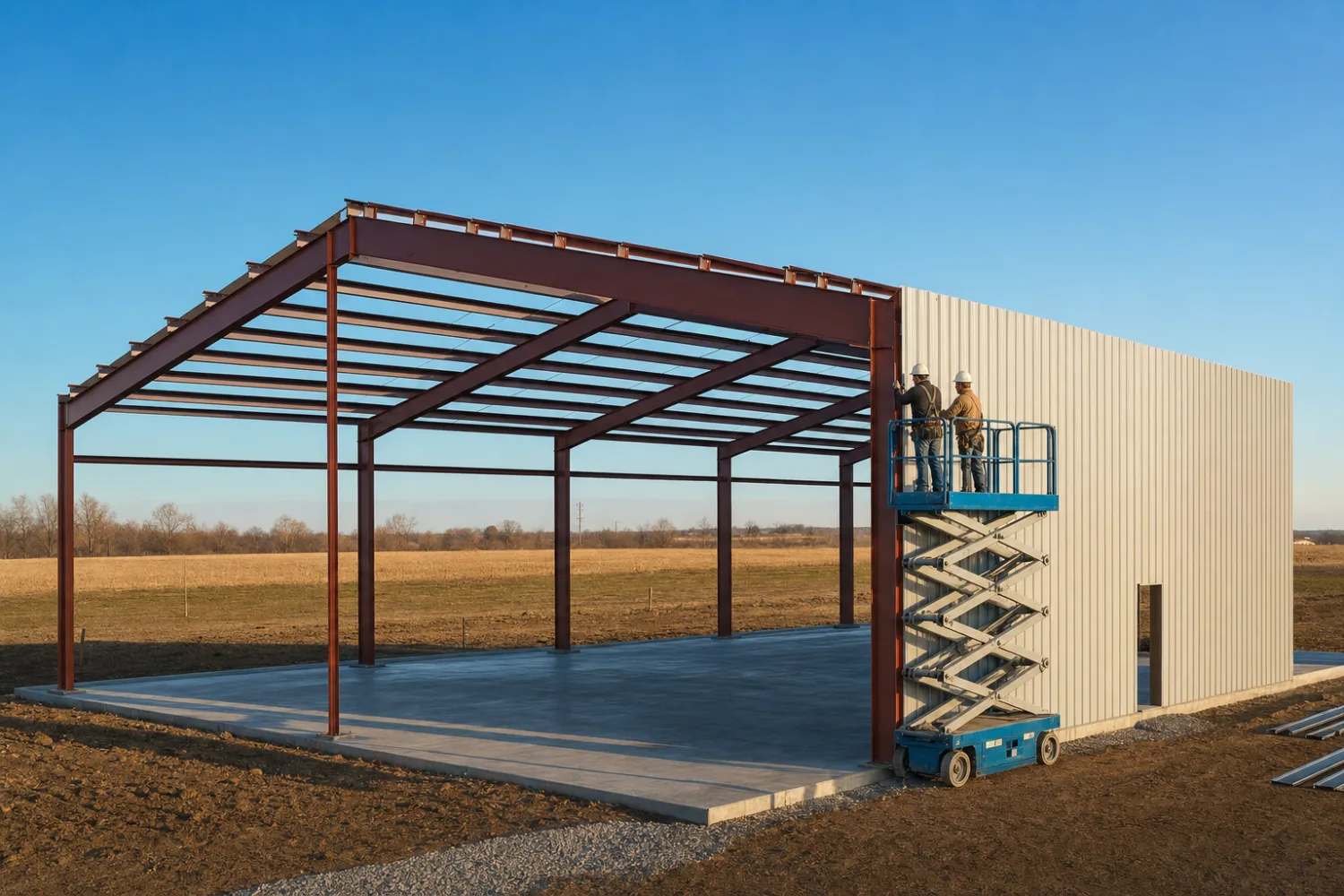
Without installation, you buy the shell and raise it yourself, which is the lowest-cost path and the reason kits exist. With installation, the supplier or a crew erects the building for you, adding labor that often runs a meaningful share of the shell price again ‹confirm›. The right choice depends on the size, your tools and help, and how much your time is worth.
| DIY (no installation) | Installed (with a crew) | |
|---|---|---|
| What you pay for | Shell only | Shell plus erection labor |
| Added cost | Your time and equipment rental | Often 25 to 50 percent of the shell ‹confirm› |
| Best size | Small garages and covers | Wide spans, tall eaves, two-story |
| You need | A lift, a helper or two, patience | A reputable, insured erector |
| Main risk | Slow going, safety on panels and rafters | Vetting the crew and the warranty |
Illustrative for 2026. Installed pricing varies widely by region and crew availability; confirm with local quotes.
A small garage kit is a realistic do-it-yourself project for a patient owner with a lift and a helper, and skipping installation is the cleanest way to cut the bill. Anything over 30 by 40, or anything with a tall eave or a second floor, leans toward a crew for safe handling of heavy panels and rafters. Compare the two paths honestly in our installed vs uninstalled guide and the DIY vs installed cost comparison.
06 / Hidden Costs
The hidden costs between sticker and finished
The hidden costs of a metal building are the lines that turn a shell into a finished building: the foundation, the permit, delivery, and insulation. None of them are truly hidden, since any honest supplier will name them if you ask, but they rarely appear in a headline price, which is how a budget gets blindsided. Add them to the steel before you call any number your total.
| Hidden cost | What it is | Illustrative 2026 range |
|---|---|---|
| Foundation | Slab or piers, anchor bolts, grading | $4–$8 per sq ft ‹confirm› |
| Permit & engineering | Building permit, plan review, site-specific stamp | A few hundred to a few thousand dollars ‹confirm› |
| Delivery / freight | Trucking the steel from the plant | Hundreds to a few thousand by distance ‹confirm› |
| Insulation | Vapor barrier, batt, or spray foam | $1–$4 per sq ft by method ‹confirm› |
| Doors & windows | Roll-up, walk doors, windows, framed openings | Hundreds to a few thousand each ‹confirm› |
| Site prep / access | Grading, gravel, crane or lift access | Varies widely by site ‹confirm› |
Illustrative 2026 ranges. Every line varies by region, soil, and finish level. Confirm each against a local quote.
The foundation is the line people underestimate most, because soil, slope, and finish all move it, and a building stamped for heavy loads needs a slab to match. The permit is small in dollars but easy to forget, and skipping it is a costly mistake. For the full list and how to budget each one, see our hidden costs guide and the site-wide cost guide, then run the buying checklist so nothing slips through.
07 / Financing & Payment
Financing and payment options
You can finance a metal building kit, and most buyers who do not pay cash use one of a few common paths: a personal or home-equity loan, supplier financing arranged through a lender, or rent-to-own for smaller buildings ‹confirm›. The right option depends on the size of the purchase, your credit, and whether you own the land. Rates and terms vary by lender and by year, so confirm current numbers before you commit.
| Option | How it works | Often suits |
|---|---|---|
| Cash / shell only | Pay outright, skip interest | Small kits, DIY budgets |
| Supplier financing | Lender arranged through the seller | Buyers wanting one-stop terms ‹confirm› |
| Personal / home-equity loan | Bank or credit-union loan you arrange | Larger, finished builds ‹confirm› |
| Rent-to-own | Monthly payments, ownership at the end | Smaller carports and garages ‹confirm› |
| No-money-down programs | Financing with little or no deposit | Qualified buyers, terms vary ‹confirm› |
Illustrative for 2026. Availability, rates, and terms vary by lender, state, and credit. Confirm before signing.
Read the financing, not just the monthly
A low monthly payment can hide a long term and a high total cost. Compare the annual rate, the term length, and any deposit, and confirm whether the financing covers only the shell or the finished building. Our financing guide and payment plans and no-money-down page walk the options and the fine print.
08 / Save Money
How to save money on a metal building kit
The honest ways to spend less on a metal building come down to buying smart, not buying the thinnest steel. Right-sizing, timing, and comparing real quotes save more than chasing the lowest sticker, and a few of them cost you nothing but patience. Here are the levers that work:
- Compare quotes line by line. Get three quotes for the same gauge, frame, eave, and door package, then compare totals. This is the single biggest saver, and it is free. See how to save money.
- Right-size the building. Order the eave height and span your use needs, not the biggest on the page. Over-building wastes steel you pay for and never use.
- Time the steel market. Mill pricing softens and firms through the year. If your project can wait, a quote during a soft stretch can save real money.
- Do your own assembly. Skipping installation on a small kit removes the largest single add-on. See the DIY vs installed comparison.
- Look at used, clearance, and wholesale. A used kit, a clearance or discounted cancelled order, or a wholesale supplier can cut the shell cost, as long as you verify the steel and the drawings.
- Choose the right structure for the job. For simple covered space, a pole barn can undercut steel; for span and life, steel wins. Run the metal vs pole barn cost numbers before you decide.
Two cautions. A cheap kit that drops to 29-gauge with no stamped drawings is not a saving if it fails an inspection or rusts early, so read the spec behind the price. And a used or clearance kit only saves money if the parts list is complete and the engineering fits your site and loads. Spend the saved money on the foundation and permit you cannot skip, not on regret.
Browse the silo
Read the Prices & Cost guides
This pillar is the front door. Each guide below goes deep on one piece of the money question. Start with the number your project needs to nail down.
Prices & cost breakdown
- How much do metal building kits cost? (full breakdown)
- Metal building cost per square foot
- Metal building kit prices by size (chart)
- What drives metal building prices (steel market, gauge, span)
Installed vs DIY & comparisons
- Cost with vs without installation
- DIY vs installed cost comparison
- Metal building cost vs pole barn cost
- Insulation costs for metal buildings
Hidden costs & saving money
- Hidden costs (foundation, permits, delivery)
- How to save money on a metal building kit
- Cheap & affordable metal building kits
Used, clearance & wholesale
Financing & payment
FAQ
Common questions about metal building kit prices
How much does a metal building kit cost?
As an illustrative 2026 range, a small two-car shell runs roughly $9k–$16k ‹confirm›, a 30 by 40 shop $14k–$24k ‹confirm›, and a 50 by 100 commercial span $58k–$98k ‹confirm›, shell only. The finished building adds the slab, permit, doors, insulation, and delivery. See the full cost breakdown.
What is the cheapest metal building kit?
The cheapest kits are small, light tube-frame carports and covers in 29-gauge steel, which can start in the low four figures ‹confirm›. Used, clearance, and wholesale kits cut the shell cost further. Just verify the gauge, the parts list, and that a stamped drawing set is included before you treat a low price as a deal. See cheap & affordable kits.
How much does a metal building cost per square foot?
As an illustrative 2026 range, a bare shell often lands around $8–$22 per square foot ‹confirm›, falling as the building gets larger, while a finished, insulated building runs roughly $18–$45 per square foot ‹confirm›. Use varies the finished figure most. See cost per square foot.
Can you finance a metal building kit?
Yes. Common paths are supplier-arranged financing, a personal or home-equity loan, and rent-to-own for smaller buildings, with no-money-down programs for qualified buyers ‹confirm›. Rates and terms vary by lender and year, so compare the annual rate and total cost, not just the monthly payment. See how to finance a kit.
How much does a foundation cost for a metal building?
A slab commonly runs about $4–$8 per square foot ‹confirm›, depending on soil, slope, thickness, and finish, with piers as a lower-cost option for some buildings. It is the hidden cost people underestimate most, and a building stamped for heavy loads needs a slab to match. See hidden costs.
How much does delivery cost?
Freight runs from a few hundred dollars close to the plant to a few thousand for a long haul ‹confirm›, because steel is heavy and you pay to move it. A minimum charge applies even nearby. The farther you sit from the fabricating plant, the more it costs, so factor distance into any quote. See hidden costs.
How much does a metal building cost with installation?
Installation, the labor to erect the shell, often adds roughly 25 to 50 percent of the shell price ‹confirm›, depending on size, eave height, and local crew rates. A small garage is a realistic DIY job that skips this cost; a wide span or two-story building usually earns a crew. See cost with vs without installation.
Are metal building kit prices negotiable?
Often, yes. Getting three quotes for the same gauge, frame, eave, and door package gives you leverage and reveals which supplier is sharpest. Timing an order when the steel market softens and bundling options can also move the number. See how to save money.
Do metal building prices go down?
They move both ways. Mill pricing swings with steel demand, tariffs, and energy costs, so a quote has a shelf life and can soften or firm within a few months. If your project can wait, ordering during a soft stretch can save real money, but no one can promise the direction. See what drives prices.
Keep exploring
Explore the rest of MetalBuildingKit
Once the budget is clear, follow the silo that fits the rest of your project. Each is its own complete reference.
- Metal building kits. The basics, anatomy, and buying process for any kit.
- Metal garage kits. One to four bays, RV and workshop sizes.
- Metal building homes & barndominiums. Shells finished for living.
- Construction types & DIY. Bolt-up, weld-up, red iron, Quonset.
- Companies & reviews. Brand-neutral looks at the major suppliers.
- Sizes. Every common footprint, square footage, and use.
- Uses & applications. Shop, ag, commercial, equestrian, and more.
- By state. Permits, codes, and loads where you live.
Reference tools you will keep coming back to: the size chart, the glossary, the cost guide, and the buying checklist.