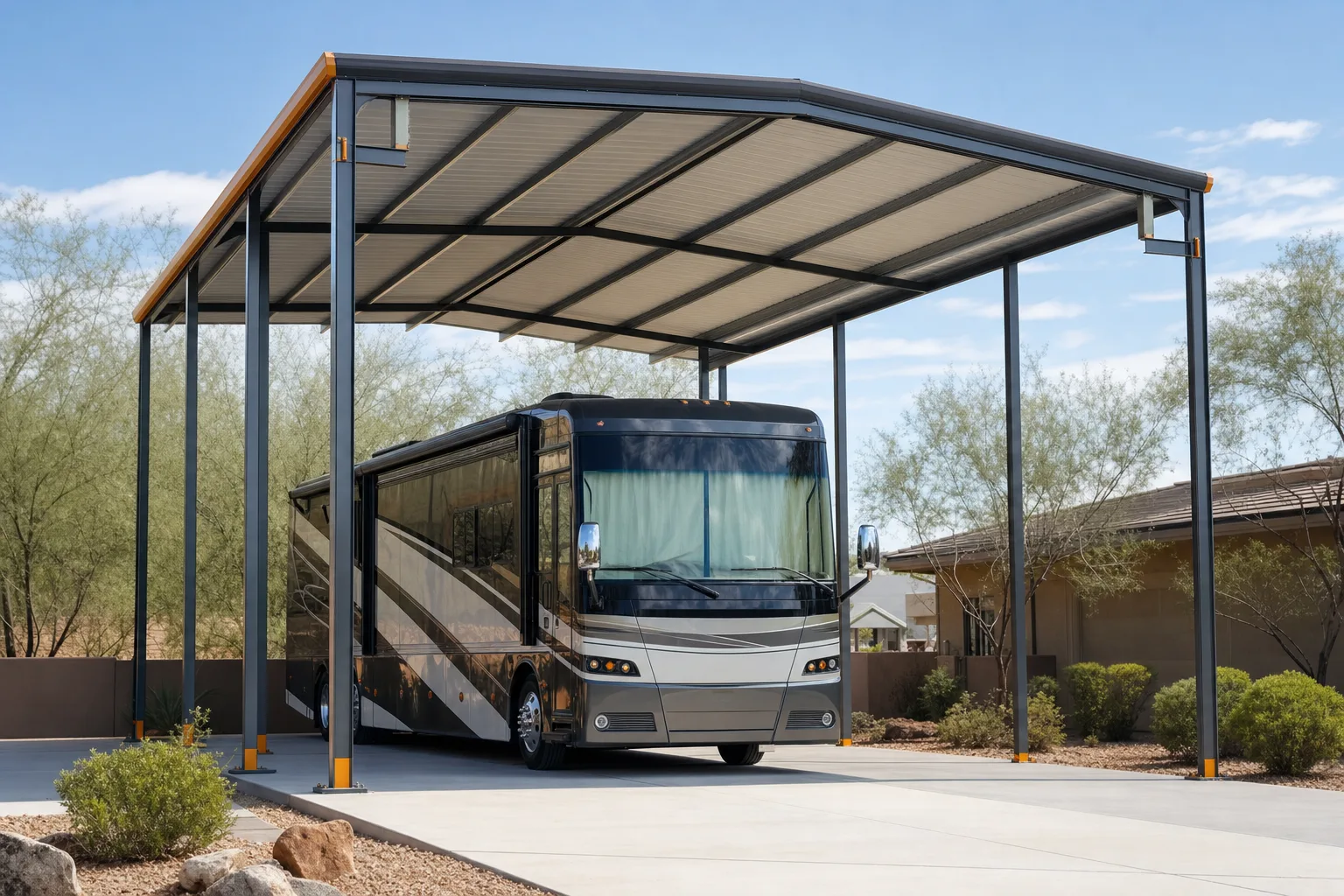
A metal RV cover is an open steel canopy, a tall carport built to park a motorhome or trailer under a roof without enclosing the sides. It blocks the two things that age a rig fastest, ultraviolet sun and standing water on the roof seals, for a fraction of what a closed building costs. Think of it as a carport stretched tall and long: steel posts on a gravel or concrete pad, a roof overhead, and the sides left open so you can pull a 40-foot coach straight through.
This guide sits under our Metal Building Uses & Applications pillar, where the same steel shell becomes a shop, a barn, or a shelter depending on how you spec it. Below: why a cover protects your RV, how it compares to a closed garage, the roof styles you can order, the height and length your rig truly needs, how it anchors to the ground, and what a metal RV cover costs. Measure your rig at its tallest point before you read the sizes, because the height you forget to plan for is the most expensive mistake on this build.
Why cover it
Why a metal RV cover protects your rig
Sun and water do the damage, and a roof stops both. An RV parked in the open bakes under ultraviolet light that chalks the paint, cracks the rubber roof membrane, and dries out the slide-out and window seals. A metal RV cover puts a roof between your rig and the sky, so the coach sits in shade and the rain runs off steel instead of pooling on a flat RV roof.
The savings show up where you cannot see them. Roof seals that stay out of the sun last years longer before they leak, tires that stay shaded resist the sidewall checking that comes from UV, and the cabin stays cooler so the interior trim and upholstery hold their color. None of that needs walls. An open cover on a light steel frame, the same family of structure as a metal carport kit, delivers most of the protection a closed building gives at a much lower price.
What a cover will not do is lock, insulate, or stop wind-driven rain, snow, and dust from reaching the sides. If you want the rig secured behind a door or kept at a steady temperature for winter storage and on-board work, that is an enclosed building, and our metal garage kits pillar covers the tall closed-bay option in full. For most owners who just want the coach out of the weather between trips, the open cover is the right tool.
Cover or closed
Metal RV cover vs enclosed RV garage
An RV cover is an open roof on posts; an enclosed RV garage adds walls and a tall door. The cover is cheaper and faster, the garage is more secure and more weatherproof, and the right pick comes down to climate, security, and budget. Read them as two ends of one range, because many owners start with a cover and add end walls or a single side later.
A cover wins on cost and speed. It rides on a lighter frame, needs less steel, and can go up over a weekend on a gravel pad. A closed garage wants a poured slab, a heavier frame, and a large door that is a line item all by itself. If the rig is your only concern and shade plus a roof solve the problem, the cover is the lowest-cost way to get there. If you also want a lockable, dry place to work on the coach, the closed building earns its higher price, and the garage kits pillar walks that path.
There is a middle ground worth knowing. You can order a cover with one or both ends gabled in, or with a single closed side facing the prevailing weather, which blocks wind-driven rain without paying for a full enclosure. A lean-to added to one leg gives you a covered spot for hoses, chairs, and gear next to the rig. That partial approach is common when an open roof is almost enough but the weather comes hard from one direction.
Roof styles
RV cover roof styles: regular, A-frame, and vertical
Covers come in three roof styles, and the difference is how the panels run and how well the roof sheds snow and water. A regular roof is the cheapest; a vertical roof handles weather best and is the one most suppliers recommend for a long RV cover. Here is how they compare:
| Roof style | How it is built | Best for |
|---|---|---|
| Regular (rounded) | Horizontal panels with rounded corners | Mild climates and tight budgets; the lowest-cost option ‹confirm› |
| A-frame (boxed) | Horizontal panels with a peaked, boxed-eave roofline | A cleaner look and better runoff than a regular roof |
| Vertical roof | Vertical panels with a ridge cap, so water and snow run straight off | Long covers, snow country, and the longest service life ‹confirm› |
Illustrative roof-style comparison. Confirm panel layout, gauge, and load rating against the supplier’s drawing for your site.
For an RV cover specifically, the roof length is the reason the vertical style matters. A regular roof runs its panels across the width with seams that can trap debris and water over a long run, while a vertical roof sheds straight off the eave the way a house roof does. If you live where snow loads up or rain comes heavy, pay for the vertical roof and get the snow and wind load rating in writing. Panel thickness matters here too, so confirm the steel gauge on both the frame and the roof.
Sizing
Sizing a metal RV cover for your rig
Height is the spec that makes or breaks an RV cover, and most buyers under-size it. You need clear room above the rig for the roof structure and a working margin, so size the cover from the top of your tallest rooftop unit, not from the brochure number. Length and width follow from the rig and how much room you want around it.
Read the height in two numbers. The leg or eave height is how tall the open side stands, and the peak is the center of the roof. The number that has to clear your RV is the leg height, because that is the open span you drive through. A travel trailer often clears 11 feet ‹confirm›, a fifth wheel runs 12 to 13.5 feet ‹confirm›, and a tall Class A motorhome stands 13 to 13.5 feet ‹confirm› at the roofline, before you add a rooftop air conditioner or antenna that can add 6 to 12 inches ‹confirm›. Measure your rig at its tallest point and leave a foot of margin above that.
- Leg height. Plan a 12 to 14-foot leg ‹confirm› for most motorhomes and fifth wheels, taller if you tow a tall rig or want walk-around headroom under the eave.
- Length. Add several feet past the rig so the cover shelters the hitch or tongue and the rear cap, not just the body. A 40-foot coach wants a cover longer than 40 feet ‹confirm›.
- Width. A single rig fits a narrow bay, but a few extra feet of width buys room to walk the sides with the awning out and to open bay doors.
If the plan is an RV plus a vehicle, a boat, or stored equipment, step up to a wider cover or a multi-bay layout instead of squeezing one width. Our multi-use buildings guide covers sharing one roof across uses, and the size chart maps widths and heights to common loads so the bay clears your slide-outs, not just the body.
Measure the rig, not the brochure
RV spec sheets often list height without the rooftop air conditioner, and that shroud is usually the tallest point on the coach. Measure from the ground to the top of the AC unit, add a foot of clearance, and size the leg height to that number. Do the same for length so the cover shelters the full rig. The frame is engineered to your numbers, so a wrong figure here is locked in before the steel ships. The buying checklist keeps these measurements in front of you before you order.
Foundation
Foundations and anchoring for an RV cover
An open cover does not need a poured slab, but it does need to be anchored hard, because a roof with open sides catches wind like a sail. The base can be a gravel pad, asphalt, or a concrete slab, and the anchor type changes with each. What does not change is that the cover has to be tied down to its engineered rating, not just set on the ground.
Match the anchor to the surface. On a compacted gravel or dirt pad, the legs take long rebar or auger-style ground anchors driven deep. On asphalt, the crew uses asphalt anchors. On a concrete slab, wedge or expansion anchors bolt the base plates down, which is the strongest hold and the one snow-and-wind country wants. The foundation options guide walks slab, pier, and pad and what each costs to prepare. Whatever the surface, the pad should be level and the approach clear so you can swing a long rig in without clipping a leg.
Wind is the load that matters most on an open structure. Because the sides are open, uplift and lateral wind do more work on the frame than they would on a closed building, so the anchoring and the bracing carry real weight. Confirm the cover is engineered and anchored for your local wind and snow loads before the truck shows up, and keep the stamped drawings on site so the crew and the inspector read the same spec language.
Cost
What a metal RV cover costs
A metal RV cover costs far less than an enclosed RV garage because it skips the walls, the door, and the slab. As a 2026 illustrative range, an open RV cover runs roughly $2,500 to $7,000 ‹confirm› for the steel, depending on the leg height, the length, the roof style, the gauge, and your local wind and snow rating. A closed RV garage, by contrast, runs several times that once you add the walls and the tall door.
Three things move the price. Leg height drives it first, since taller legs use more steel per foot of length, and an RV cover stands far taller than a car carport. The roof style is next, with a vertical roof costing more than a regular one but lasting longer and shedding weather better. Local loads are the third, because a cover rated for heavy snow or high wind needs more steel and heavier anchors. For where a cover sits against closed buildings, see the cost guide and the metal building kit prices pillar.
Where the cover pays you back is downstream. An RV kept out of the sun holds its roof seals, its tires, and its finish years longer, and a sheltered coach resells better than one that bakes on an open pad. The frame itself is low-maintenance steel, and a galvanized or coated finish shrugs off rust on a structure that takes weather on every open side. Buy the height and the roof you need once, because re-leveling a pad and re-engineering a taller frame later costs far more than ordering it right the first time.
Size the cover to the rig and the weather, not to the sticker price. A roof your motorhome cannot fit under is the most expensive cheap cover you can buy.
Other uses
More than an RV: what else a cover shelters
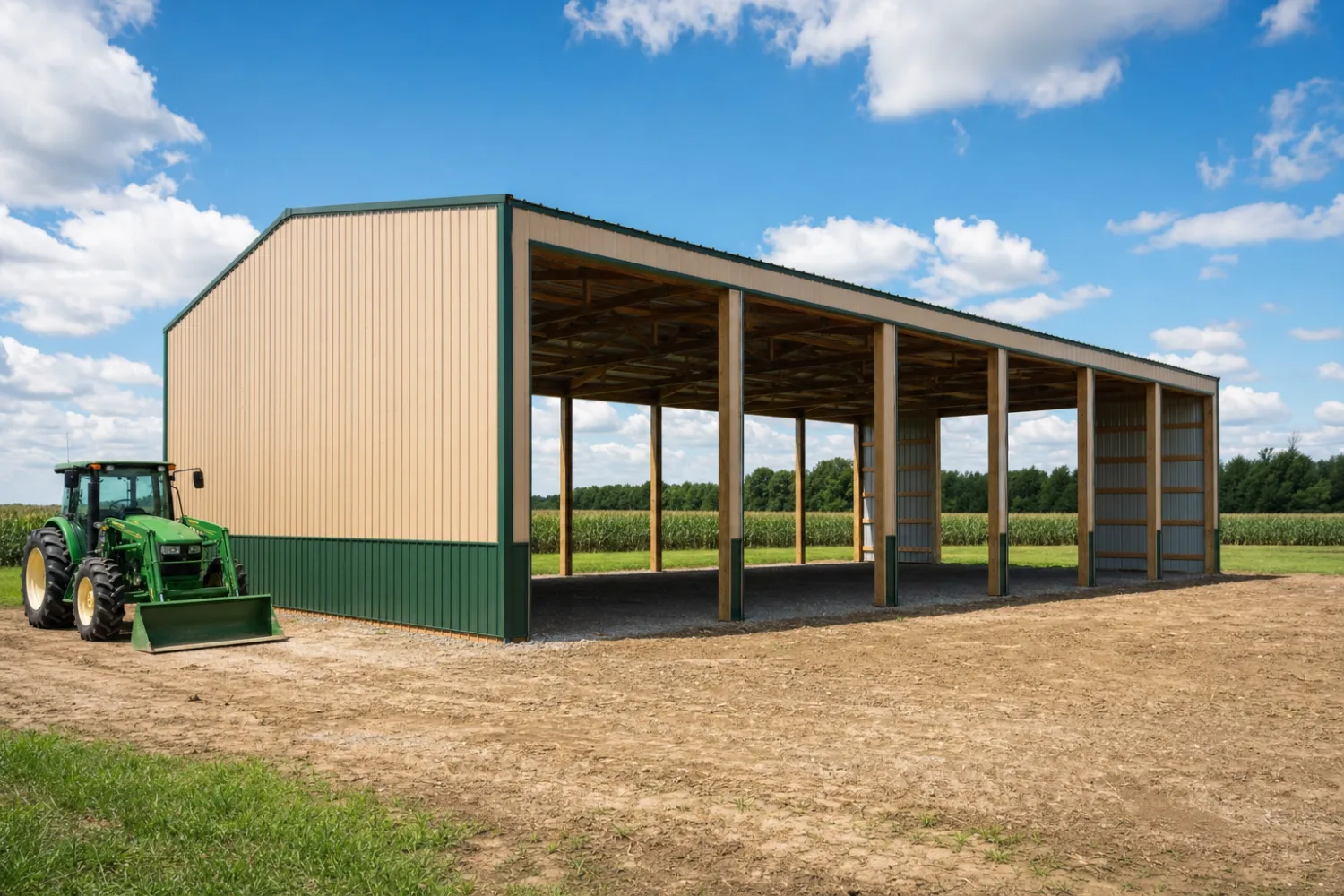
The same tall open cover that shelters an RV works for anything large you want out of the sun. A cover sized for a motorhome easily takes a boat on a trailer, a stock trailer, or a piece of equipment, which is why owners often buy one bay bigger than the rig alone needs. Decide the secondary use before you size, because adding width to an engineered frame later is the change you cannot retrofit.
- Boats and trailers. A tall cover keeps a trailered hull or a utility trailer out of the weather alongside the rig; the carport kits guide covers the open-cover family at every size.
- Equipment and implements. Tractors, mowers, and attachments store well under an open roof; see equipment & implement storage for that fit.
- General gear and seasonal storage. For smaller items and a lockable spot, a metal storage shed or a lean-to off the cover handles what an open bay cannot.
FAQ
Metal RV cover: common questions
How tall does a metal RV cover need to be?
Size the leg height to the top of your tallest rooftop unit plus a foot of margin. Most motorhomes and fifth wheels want a 12 to 14-foot leg ‹confirm›, since a tall Class A stands 13 to 13.5 feet ‹confirm› at the roofline before you add a rooftop air conditioner. The leg height is the open span you drive through, so measure the rig and size from there.
Is an RV cover better than an enclosed RV garage?
It depends on what you need. A cover is cheaper, faster, and stops the sun and rain that do most of the weather damage. An enclosed garage adds security, insulation, and a dry place to work, at a higher price and with a poured slab. If shade plus a roof solve your problem, the cover wins on cost; if you want the rig locked or kept at a steady temperature, the closed building earns its money.
How much does a metal RV cover cost?
As a 2026 illustrative range, an open RV cover runs roughly $2,500 to $7,000 ‹confirm› for the steel. Leg height, length, roof style, gauge, and your local wind and snow rating set where it lands. A taller leg and a vertical roof cost more but last longer and shed weather better. The pad, anchors, permits, and delivery are separate line items on top of the kit price.
What roof style is best for an RV cover?
A vertical roof is the one most suppliers recommend for a long RV cover, because its panels run with the slope and shed snow and water straight off the eave. A regular rounded roof is the cheapest and fine for mild climates ‹confirm›, while an A-frame boxed roof sits in between on price and runoff. In snow or heavy-rain country, pay for the vertical roof and confirm the load rating.
Do I need a concrete slab for an RV cover?
No. An open cover can sit on a compacted gravel pad, asphalt, or a concrete slab, and the anchor type changes with each surface. Gravel takes long ground anchors, asphalt takes asphalt anchors, and concrete takes wedge or expansion bolts, which give the strongest hold. Because the sides are open, the cover has to be anchored to its engineered wind rating whatever the surface.
Will an RV cover hold up in wind?
Yes, if it is engineered and anchored for your local wind load. An open roof catches more uplift and lateral wind than a closed building, so the frame, the bracing, and the anchors carry real weight on a cover. Confirm the build is rated for your area’s wind and snow before you order, and have the legs anchored to the stamped drawing, not just set on the ground.
Can I put walls on an RV cover later?
Often yes, if the frame is engineered for it from the start. Many covers can be ordered open and later gabled in at the ends or closed on one side against the prevailing weather. Tell the supplier you may enclose it later so the frame is sized for the added wall loads, because adding walls to a frame that was not engineered for them is not a safe retrofit.
Related guides
Keep reading
A metal RV cover touches roof style, sizing, anchoring, and cost. Follow these next:
- Metal building uses & applications (the parent pillar).
- Metal carport kits (the open-cover family at every size).
- Lean-to storage buildings (a covered add-on next to the rig).
- Equipment & implement storage (when the cover also shelters gear).
- Multi-use buildings (one roof shared across an RV, a boat, and storage).
- Metal garage kits (the enclosed, lockable RV-garage option).
- Metal building size chart (match a footprint and height to your rig).