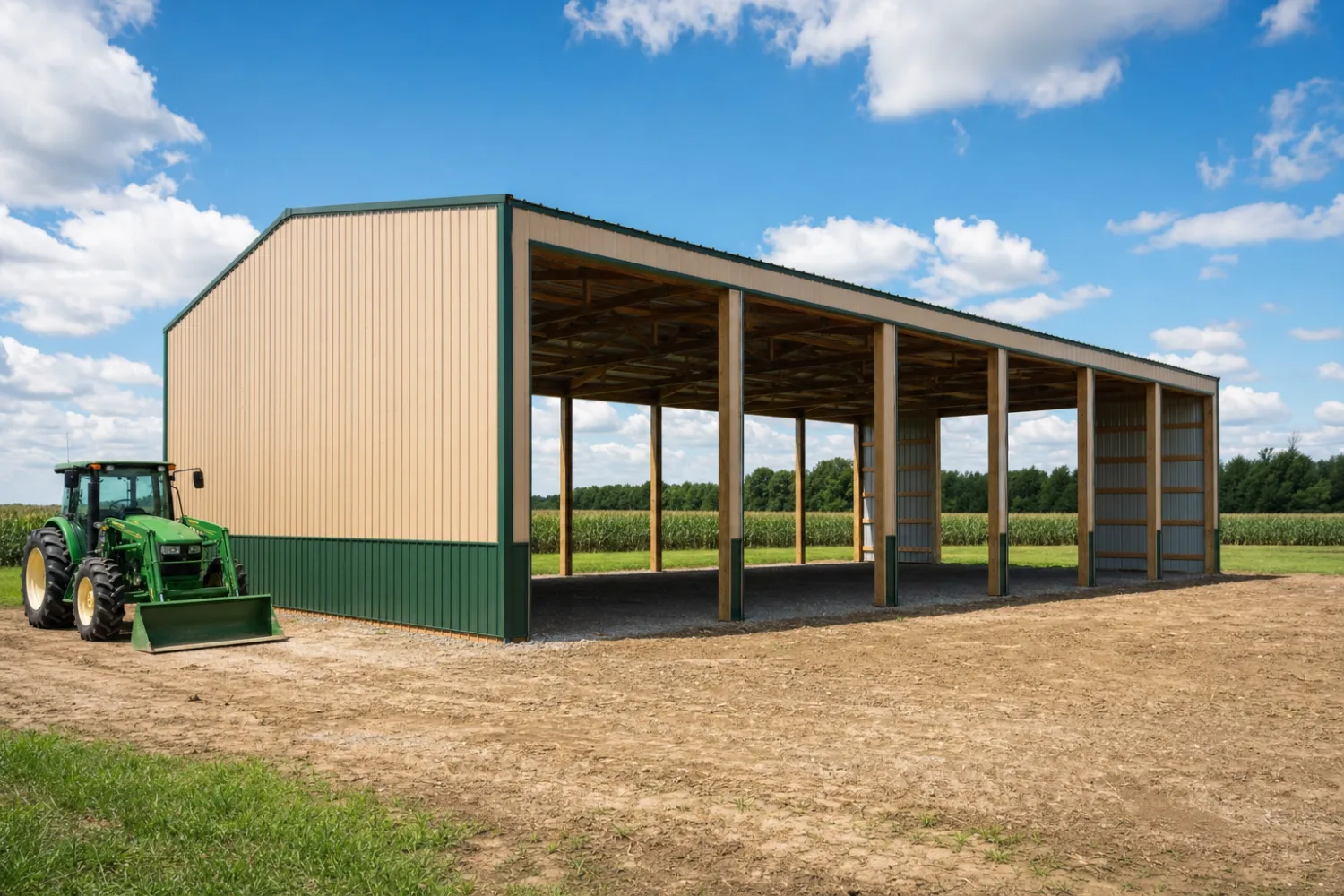
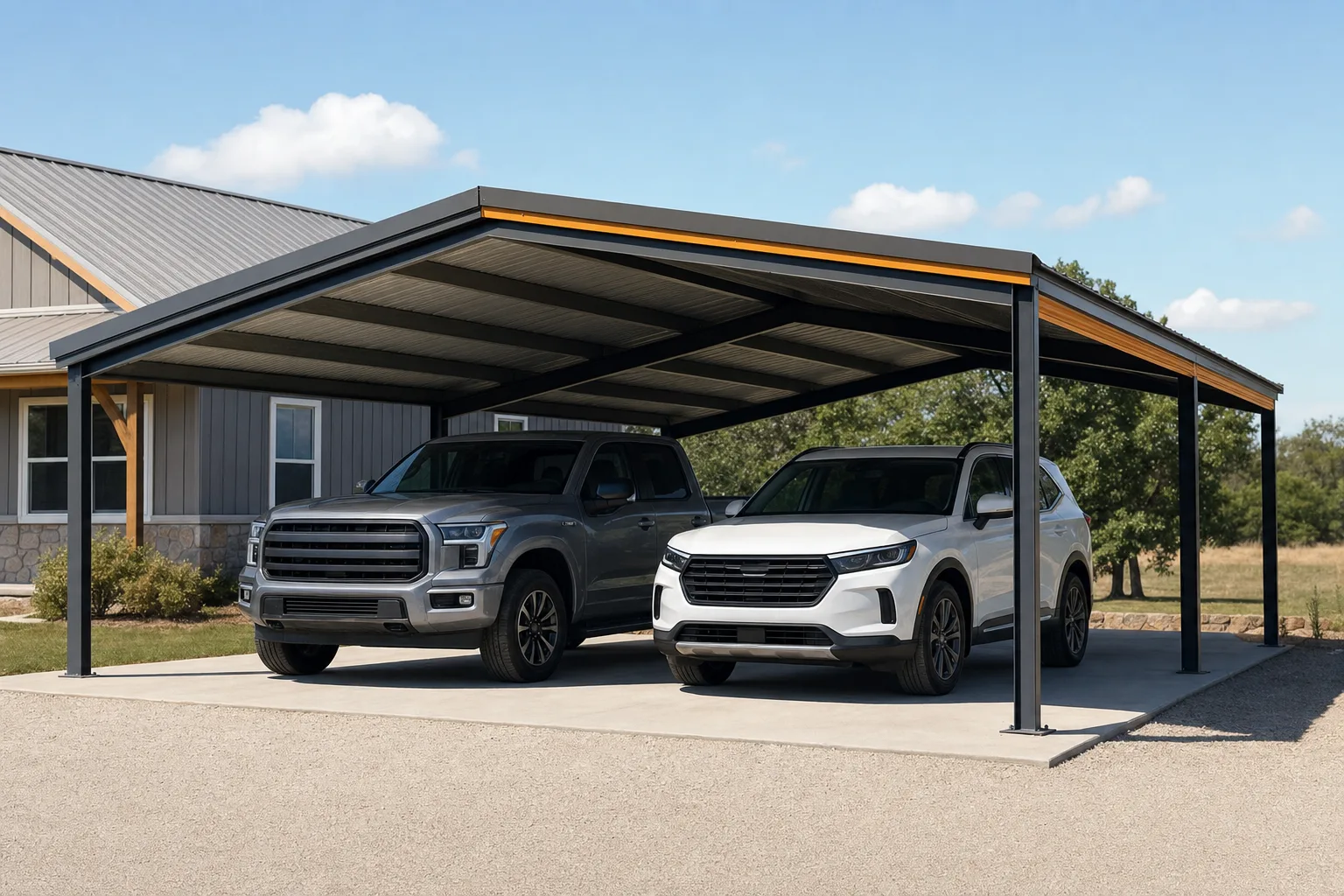
A metal carport kit is a pre-engineered, open-sided steel cover that ships as a bolt-together package to shelter a vehicle, a boat, or equipment. The frame is light galvanized tube steel, the roof is steel panel, and the sides stay open or get paneled to taste. It is the simplest building in the steel family: a roof on legs, anchored to the ground, sized for one car up to a small fleet. You get weather protection without the cost, the slab, or the permit weight of an enclosed garage.
This guide sits under our Metal Building Uses & Applications pillar, where the same steel idea scales from a one-car cover to a full warehouse. Below: what a carport kit is and how it is framed, the three roof styles and which sheds snow, how to size one, how to anchor it to dirt or concrete, what it costs, and when a carport is the wrong answer and you want a garage instead.
What it is
What a metal carport kit is
A metal carport kit is a roof and frame, not a building you close up. The package arrives as cut-to-length steel tube, roof panels, brackets, and hardware, and you bolt it together on a prepared pad. With the sides open it is a carport; add wall panels and a door and it inches toward a garage. The point is shelter at the lowest honest price.
Almost every carport kit rides on a light steel frame rather than the heavy structural steel under a shop or barn. That is a deliberate match of frame to load: a cover over one car never needs the wide clear span and snow rating of a 50-foot building. If you want the difference between the two framing systems spelled out, the construction types pillar lays out tube steel against red iron.
The open design is the feature, not a compromise. Air moves through, so a carport rarely sweats the way a sealed building can, and you skip the insulation and ventilation a closed shell needs. If you later want walls, most kits let you panel one, two, or three sides, which is the bridge toward an enclosed metal garage without starting over.
The frame
Tube gauge and the galvanized coating
The whole frame is hollow steel tube, and two specs decide how much it can take: the wall thickness, measured in gauge, and the coating. On gauge, a lower number means thicker steel. You will see 14-gauge tube on lighter, budget carports and 12-gauge on stouter covers built for wind and snow ‹confirm›. The 12-gauge upgrade is the one that earns its cost in weather country.
Most carport tube ships galvanized, coated in zinc so it fights rust without paint. That matters more on a carport than on most buildings, because an open cover takes weather on every side, all year, with no sealed shell to hide behind. The galvanized vs Galvalume vs painted steel guide covers how those finishes hold up over decades.
Frame spacing is the third lever. Standard kits set the bows, the curved or peaked roof members, on five-foot centers, and tightening them to four-foot centers adds strength for snow or wind. When you compare two quotes, read the gauge and the spacing together, because a thin frame spread wide is a different building from a thick frame set tight, even at the same size.
Roof styles
Regular, boxed-eave, and vertical roof
Carport kits come in three roof styles, and the choice is mostly about how the building sheds water and snow. Regular is the cheapest and the curved one; boxed-eave gives the building a house-like A-frame look; vertical roof runs the panels up and over the peak so water and snow run off the ends instead of pooling. For anything past light rain country, vertical roof is the one worth the upcharge.
| Roof style | Look | Best for |
|---|---|---|
| Regular (round) | Curved corners, horizontal panels | Mild climates, tightest budget, short-term cover |
| Boxed-eave (A-frame) | Peaked roof, horizontal panels | A more finished, house-matching look in moderate weather |
| Vertical roof | Peaked roof, panels run ridge to eave | Snow and heavy rain; panels shed instead of pooling |
Illustrative comparison, not a verdict. In snow or heavy rain, the vertical roof is the style most suppliers recommend ‹confirm›.
Match the roof to your weather, not the sticker
The regular roof is the cheapest line on the quote, and in snow country it is the costliest mistake, because horizontal panels and a low pitch let snow sit. Spend the upcharge on a vertical roof if you see real winters, and confirm the cover is rated for your local snow and wind loads before you order, certified rather than guessed.
Sizing
What size metal carport you need
Size the carport around the vehicle plus working room, then add height for anything tall. A single cover starts near 12×21, a double around 18×21 to 20×21, and a triple around 24×26 ‹confirm›, with length easy to extend in increments. Map these footprints against the metal building size chart to see how width and length pair up before you commit.
| Cover | Common size ‹confirm› | Fits |
|---|---|---|
| Single | 12×21 to 12×26 | One car or truck, plus a little working room |
| Double | 18×21 to 20×26 | Two vehicles side by side, or one plus a workbench |
| Triple | 24×26 to 24×36 | Three vehicles, or two plus a boat or trailer |
| Tall / RV | 12×30+ with a 12 ft+ leg | A motorhome or a lifted rig that needs the height |
Illustrative starting sizes ‹confirm›. Confirm against your own vehicles and the clearance you want to walk around them.
Leg height is the spec people under-buy first. A standard six-foot leg clears a car, but a truck with a roof rack, a boat on a trailer, or a motorhome wants nine, ten, or twelve feet ‹confirm›. If a tall rig is the whole reason you are buying, a purpose-built metal RV cover is sized and braced for that height, and this general carport guide will leave you short.
On the ground
Anchoring and the ground under it
A carport is light, which is its strength on price and its weakness in wind, so the anchors are not optional. The legs bolt down with anchors matched to the surface: rebar or auger anchors driven into bare ground, asphalt anchors into a paved drive, or wedge anchors into a concrete slab. The foundation options guide walks the slab-versus-ground choice and what each costs.
Concrete is the strongest base and the cleanest floor, and it gives the wind anchors something solid to bite. Bare ground or gravel is cheaper and gets a carport up fast, but the anchors hold less, so a wind-rated cover on dirt still wants the heaviest ground anchors the kit offers. Decide the pad before the kit shows up, since pouring a slab after the fact means moving the whole structure.
Anchoring is also where a certified carport pulls ahead of a generic one. A certified kit is engineered and stamped for a wind and snow rating, with an anchor schedule to match, which is what a permit office and most insurers want to see. The buying checklist lists what a complete, certified quote should spell out before you sign.
Cost
What a metal carport kit costs
A metal carport is the cheapest way into a steel cover. As a dated 2026 illustration, a single cover often runs in the rough range of $1,200 to $3,000, a double around $2,500 to $5,000, and a triple from there up ‹confirm›, before the pad and any permit. Gauge, roof style, leg height, and your wind and snow rating move the number more than size alone. See the metal building kit prices pillar for how each line is built up.
Spend where the weather hits: the 12-gauge frame, the vertical roof, and tight bow spacing all buy capacity you will use the first hard winter or windstorm. A fancy color does not. The pad is the line buyers forget, since a poured slab can rival the kit itself in cost. For the full picture across every steel building, the reference cost guide shows where the money goes and where buyers overspend.
Read the freight and the permit before you call one quote cheaper than another. A low sticker that drops delivery and the certified rating can cost more than a higher quote that includes both. Price the building you will install, anchors and stamp and all, not the headline number.
Carport or more
When a carport is the right call, and when it is not
A carport is the right answer when you want weather cover at the lowest price and you do not need to lock anything up. It is the wrong answer when security, climate, or a real workspace matters, because open sides give you none of those. Here is where the common projects land, so you point yourself at the right guide:
- Cover a car, boat, or trailer. A plain carport is the build, and this is your guide. For a tall motorhome, switch to the metal RV cover sibling.
- Lock it up or heat it. Once you want walls, a door, and security, you want an enclosed metal garage, not a paneled carport.
- Add cover against an existing building. A single-slope lean-to attaches to a wall and is often the cheaper way to shade a side yard.
- Shelter implements or stacked gear. For tractors, mowers, and seasonal storage, see equipment & implement storage and metal storage sheds.
- Cover a fleet or work trucks. A row of bays for vehicles you run for work is its own build; start with truck, semi & fleet garage buildings.
Buy the carport for what it is: the cheapest honest cover for a vehicle. The moment you need to lock it, heat it, or work in it, you are buying a garage, and paying carport money for it leaves you short.
FAQ
Metal carport kits: common questions
How much does a metal carport kit cost?
As a dated 2026 illustration, a single cover often runs roughly $1,200 to $3,000, a double around $2,500 to $5,000, and a triple up from there ‹confirm›, before the pad and any permit. Gauge, roof style, leg height, and the wind and snow rating move the price more than footprint alone. Always confirm with a real quote that includes freight and the certified stamp.
Can I install a metal carport kit myself?
Often yes, for a small single or double cover. The kit ships cut to length with brackets and hardware, and a couple of people with hand tools and a level can raise it on a prepared pad in a day or two. Larger covers, tall legs, and concrete anchoring are where many buyers add help or pay for installation. Confirm whether install is included in your quote.
Do I need a concrete slab for a metal carport?
No, a carport can anchor to bare ground or gravel with the right anchors, which keeps the cost down and the install fast. Concrete is stronger, gives the wind anchors a solid bite, and leaves you a clean floor, so it is worth it in wind country or if you want a finished space. Match the anchor type to whatever surface you choose.
What is the strongest metal carport roof style?
The vertical roof. Its panels run from the ridge down to the eaves, so rain and snow shed off the ends instead of pooling on a flat run, and it pairs with a peaked frame that takes load better than the curved regular roof. In snow or heavy rain, the vertical roof is the style most suppliers recommend, and it is worth the upcharge.
What gauge steel is best for a carport?
For a light cover in mild weather, 14-gauge tube is often enough. In wind or snow country, 12-gauge gives you a thicker, stronger frame, and the upgrade is the one that pays off the first hard season ‹confirm›. Read the gauge and the bow spacing together, since a thick frame set tight is a different building from a thin one spread wide.
Do I need a permit for a metal carport?
It depends on your local rules, the size, and whether it is anchored permanently. Many areas treat a carport over a certain footprint as a permitted structure, and a permit office will want a certified, engineered kit with an anchor schedule. Check with your local building department before you order, and buy a certified kit if a permit is in play.
What is the difference between a carport and a metal RV cover?
A standard carport is a low-to-medium cover sized for cars and trucks, while a metal RV cover is taller and braced for the height and wind load of a motorhome. If a tall rig is the whole reason you are buying, the purpose-built RV cover is sized for it; a general carport with a short leg will leave you short on clearance.
Related guides
Keep reading
A carport sits next to the rest of the steel-cover family. Follow these next:
- Metal building uses & applications (the parent pillar).
- Metal RV cover & carport kits (the taller cover for motorhomes and tall rigs).
- Lean-to storage buildings (the single-slope cover that attaches to a wall).
- Equipment & implement storage (open cover for tractors and gear).
- Metal storage sheds (when you need enclosed, lockable storage instead).
- Metal building size chart (match a width and length to your vehicles).
- Metal building cost guide (kit plus pad, line by line).