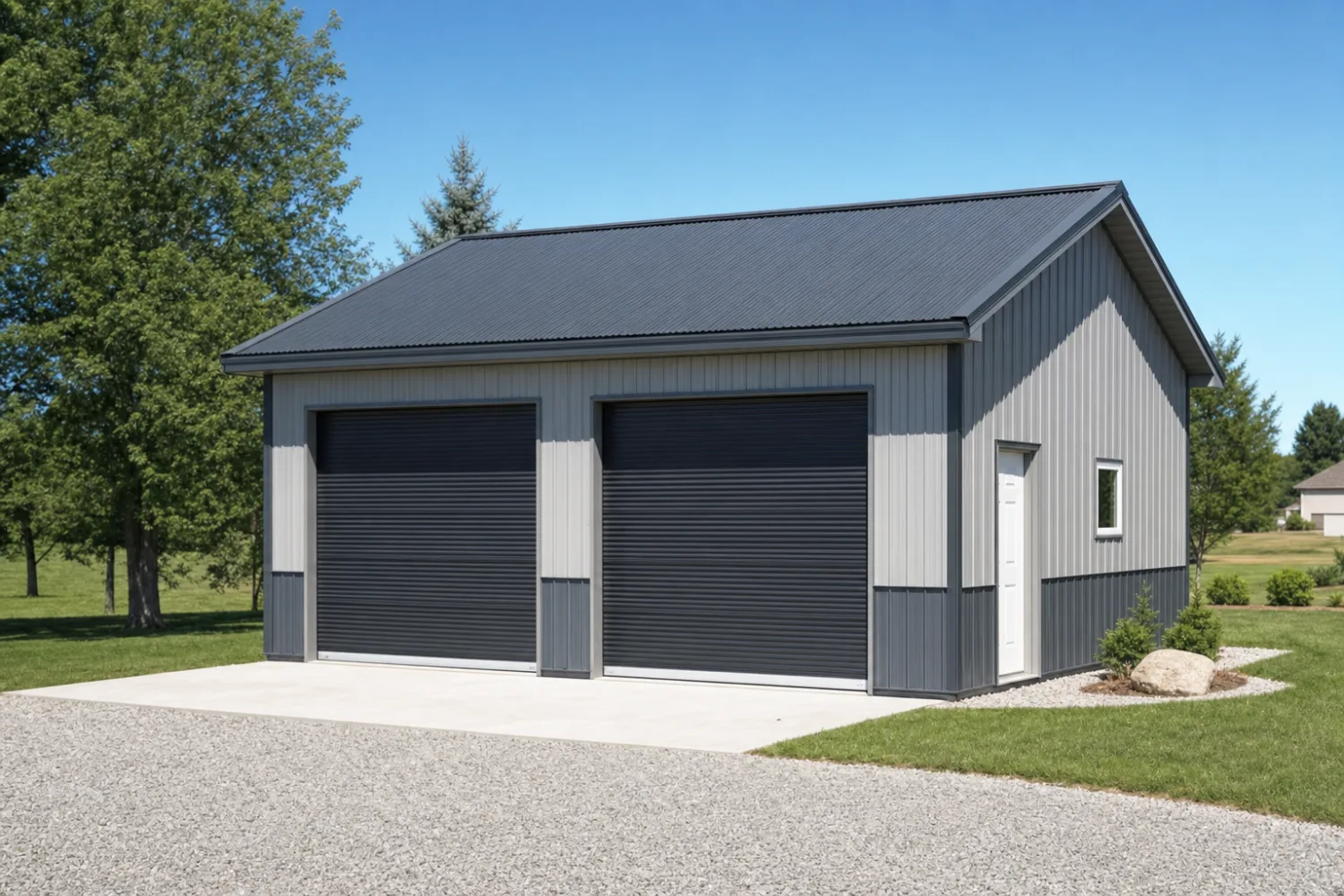
A 1-car metal garage is a single-bay steel building, usually 12 to 14 feet wide and 20 to 26 feet long, sized to hold one vehicle with room to walk around it. It ships as a labeled kit of frame, panels, and fasteners that bolts onto a slab you pour. One garage door, one or two service doors, and a stamped drawing set for your local wind and snow come with it. It is the smallest enclosed garage most suppliers build, and the easiest to put up yourself.
This guide sits under the metal garage kits pillar. Below: what width and length count as a true 1-car, the common sizes and what each one holds, who the single bay suits, and what it costs to buy and stand up. If you are weighing a single bay against a wider build, this is the context that keeps you from buying too much steel or too little room.
The single bay
What counts as a 1-car metal garage
A 1-car metal garage is a single-bay enclosed building wide enough for one vehicle plus working clearance, and tall enough to clear its door. The point is not just parking. It is parking with room to open both doors, walk the sides, and keep a workbench or shelving against one wall.
Width is the number that defines the bay. A car needs roughly 8 feet of clear space to park and step out without banging a door; a pickup or a small SUV wants more. That is why most single-car steel garages start at 12 feet wide and stop short of 16, the point where a second narrow vehicle starts to fit and the building stops being a 1-car at all.
Length sets what else shares the bay. Twenty feet parks a sedan with a few feet to spare. Twenty-four to twenty-six feet swallows a full-size truck or leaves a sedan plus a workbench across the back wall. Height matters too: an 8-foot leg clears a standard door, while a 9 or 10-foot leg lets you fit a taller garage door for a lifted truck or a small camper.
Sizes
Common 1-car metal garage sizes
Single-car steel garages cluster around a handful of footprints. The right one comes from what you park and what else has to share the floor, not from the lowest price. Here is how the common sizes land:
| Size (W x L) | Floor area | Good for |
|---|---|---|
| 12 x 20 | 240 sq ft ‹confirm› | Compact car or sedan, tight clearance |
| 12 x 24 | 288 sq ft ‹confirm› | Sedan or small SUV plus a narrow workbench |
| 14 x 21 | 294 sq ft ‹confirm› | Full-size car with easy door clearance |
| 14 x 26 | 364 sq ft ‹confirm› | Pickup or SUV plus storage at the back |
| 12 x 26 | 312 sq ft ‹confirm› | Long sedan or a car plus shelving run |
Illustrative single-bay footprints. Confirm the exact dimensions and door height a supplier quotes against the vehicle you park.
Notice the pattern: you buy length for what shares the bay and width for door clearance. If you are torn between the widest 1-car and the narrowest two-bay, read our 2-car metal garage kits guide before you decide, because the jump from 14 to 20 feet wide changes the slab, the frame, and the price more than the length does.
Order by the vehicle, not the label
A “1-car” tag means one bay, not one fixed size. Measure your longest vehicle, add 4 feet of working room, and round up to the next stock length. Then check the size chart so the width clears your doors with the car parked, not empty.
Who it suits
Who a 1-car metal garage is right for
A single bay is the right call when you are protecting one vehicle or carving out one small, lockable space. It is the wrong call when you already know a second car, a boat, or a shop is coming. Here is who the size fits:
- One daily driver. A single car or truck you want out of the sun, hail, and snow. The most common reason people buy a 1-car.
- A small workshop or hobby space. Park nothing and the bay becomes a tidy shop. If that is the goal, compare a single bay against a workshop-garage combo before you size down.
- A tight lot or strict setback. When the property line or a permit leaves little room, a 12 or 14-foot-wide building fits where a wider one will not.
- A budget-first first building. The single bay is the cheapest enclosed garage on most price lists, which makes it a common entry point. See the garage kit prices guide for where it sits.
It is the wrong size if you can see a second vehicle, a trailer, or real shop space in the next few years. Steel does not expand, and adding a bay later costs more than buying it now. If any of that is on the horizon, size up or look at a detached build you can place with room to grow.
Door and slab
The garage door and slab for a single bay
A 1-car garage takes one main door and a slab sized to its footprint, and both are cheaper here than on any larger build. The standard single door is 9 feet wide by 7 feet tall, enough for a car or a standard pickup. Go to 9 by 8 or 10 by 8 for a taller truck or a roof rack. Our garage door sizes guide walks the openings in detail.
The slab is a poured concrete pad matched to the building footprint, with a thickened edge where the frame anchors down. A single bay needs far less concrete than a wider garage, which is part of why it is the cheapest to build. Plan the floor before you order, because the anchor pattern and any drains go in before the steel arrives, not after.
One detail that trips up first-time buyers: the slab carries the wind and uplift loads, so it has to be poured to the engineer’s spec, not just a generic pad. Confirm the slab drawing matches the footprint and anchor layout on your stamped plans before the truck shows up.
Cost
What a 1-car metal garage costs
A 1-car metal garage kit is the lowest-priced enclosed building on most supplier lists, because it uses the least steel and the smallest slab. As a 2026 illustrative range, a single-bay kit runs roughly $4,000 to $9,000 ‹confirm› for the building alone, before the concrete, the door, and any insulation. Width, leg height, gauge, and your local wind and snow rating move it inside that band.
The kit price is not the project price. Budget separately for the slab, a poured pad that can rival the steel on a small build, plus the garage door opener, permits, and delivery. For the full stack of line items and where each dollar goes, the garage kit prices guide breaks it down, and the cost guide covers the project as a whole.
Where a single bay saves you is everywhere at once: less steel, less concrete, one door, and a frame light enough to raise without a crane. Where it can cost you is later, when a building you have outgrown gets replaced instead of extended. Buy the size you will use in five years, not the one that clears today’s lot by inches.
Putting it up
Standing up a 1-car kit yourself
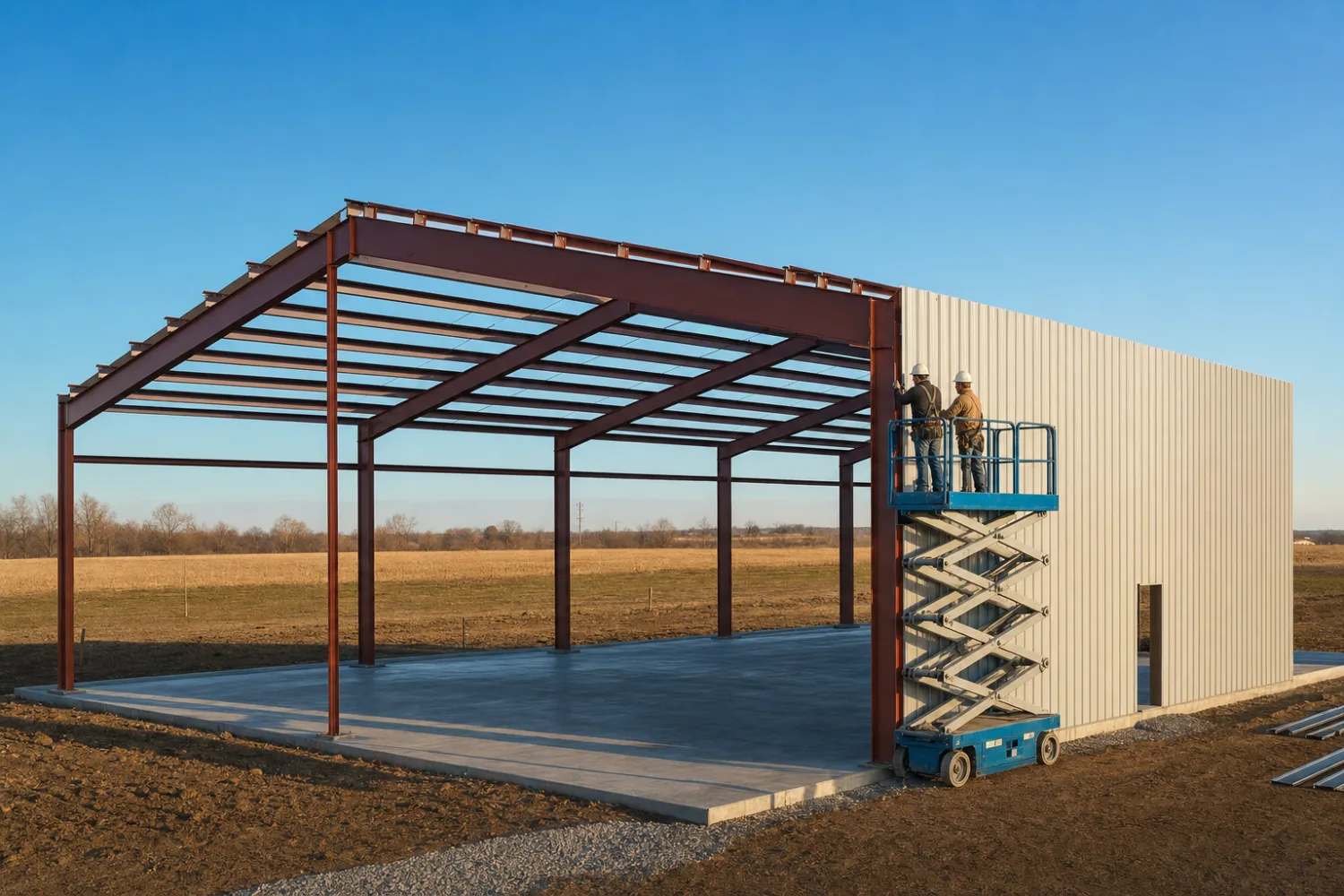
The single bay is the most DIY-friendly enclosed garage there is. The frame is light, the spans are short, and a careful pair of people can bolt one up over a weekend or two with hand tools and a ladder, once the slab has cured. Heavier or wider buildings start to want lifts and a crew; a 1-car usually does not. The garage kits pillar covers the assembly arc end to end.
Size the garage to the vehicle and the lot, not to the sticker price. A single bay you have outgrown is the most expensive cheap building you can buy.
Two things make or break a self-build: a square, level slab and a methodical bolt sequence. Get the pad right and the frame falls into place; get it wrong and every panel fights you. If you are not pouring it yourself, line up a concrete crew early, and keep your stamped plans on site so the inspector and your helpers read the same spec language.
FAQ
1-car metal garage kits: common questions
What size is a 1-car metal garage?
Most single-car steel garages run 12 to 14 feet wide and 20 to 26 feet long, sized to hold one vehicle with room to open the doors and walk the sides. Twelve by twenty parks a car; fourteen by twenty-six fits a full-size truck with storage behind it. Order by the vehicle you park, then round up to the next stock length.
How much does a 1-car metal garage kit cost?
As a 2026 illustrative range, a single-bay kit runs roughly $4,000 to $9,000 ‹confirm› for the steel alone, before the slab, the garage door, and insulation. Width, leg height, gauge, and your local wind and snow rating set where it lands. The slab and door are separate line items that can add a few thousand dollars more ‹confirm›.
Will a truck fit in a 1-car metal garage?
A full-size pickup fits a 1-car garage if you size it right: plan on 14 feet wide and 24 to 26 feet long, with a 9-by-8 or 10-by-8 door for the height. A standard 12-by-20 is built for a car and gets tight with a truck. Measure your vehicle and add working clearance before you choose.
What is the standard door size for a 1-car garage?
The common single garage door is 9 feet wide by 7 feet tall, which clears a car or a standard pickup. Step up to 9 by 8 or 10 by 8 for a lifted truck, a roof rack, or a small camper. The door opening is set in the frame order, so confirm it before the kit is engineered.
Do I need a concrete slab for a 1-car metal garage?
For an enclosed garage, yes. The slab anchors the frame and carries the wind and uplift loads, so it has to be poured to the engineer’s spec, not a generic pad. A single bay needs the least concrete of any garage, but the anchor pattern and any drains still go in before the steel arrives.
Can I assemble a 1-car metal garage myself?
A 1-car kit is the most DIY-friendly enclosed garage. The frame is light and the spans are short, so a careful pair of people can bolt one up over a weekend or two with hand tools, once the slab has cured. A square, level pad and a methodical bolt sequence matter more than muscle.
Is a 1-car or 2-car metal garage a better value?
It depends on your horizon. A 1-car is the cheapest enclosed garage to buy and build, but a 2-car costs less per square foot and rarely gets outgrown. If a second vehicle or a shop is anywhere in your plans, the wider bay usually wins. Compare them in our 2-car metal garage kits guide.
Related guides
Keep reading
Sizing a single bay touches doors, floors, price, and the wider options. Follow these next:
- Metal garage kits: the complete guide (the parent pillar).
- 2-car metal garage kits (when one bay is not enough).
- Metal garage door options & sizes (single-door openings and heights).
- Metal garage kit prices (where a single bay sits on the price list).
- Metal garage flooring options (slab and floor choices before you order).
- Carport vs enclosed metal garage (if a cover might do the job).
- Metal building size chart (footprints and clearances by use).