A metal building in Georgia answers to three things before anything else: a local permit, engineer-stamped drawings, and the wind exposure of your county. Georgia sets statewide minimum construction codes, but your county or city issues the permit and runs the inspections, so the rules that bind your project are local. Plan for stamped engineered drawings and a permit on any permanent structure, and treat coastal wind near Savannah as a separate design problem from the calmer inland counties.
This guide sits under our metal buildings by state pillar and covers what changes when you build in Georgia: how codes and permits work, the wind, snow, and seismic loads that drive the frame, the climate zones that shape insulation, what moves price here, and the metro building departments you will deal with. Loads and permit thresholds are set by your jurisdiction, so every number below is a typical range to verify with your local building department, not a statewide rule.
Codes & permits
Georgia codes and permits, and who enforces them
Georgia adopts statewide minimum standard codes, but your county or city enforces them and issues the permit. The state mandatory codes are built on the International Building Code for commercial work and the International Residential Code for homes and accessory structures, published with Georgia amendments by the Department of Community Affairs ‹confirm›. The exact code edition and any local amendments vary by jurisdiction, so confirm the current edition with your local building department before you order a kit.
Most Georgia jurisdictions require engineer-stamped, sealed drawings for a metal building, prepared or reviewed by a Georgia-licensed professional engineer, so the structure can be checked against local wind and snow loads ‹confirm›. Permit thresholds differ by county. Bryan County, for example, requires a permit for any structure greater than 200 square feet or one placed on a permanent foundation ‹confirm›, while other counties set their own size triggers and zoning setbacks. For the full mechanics of approval, read our metal building permits and codes guide, then verify with your local building department, because the size cutoff, the stamp requirement, and the fee are all set where you build.
Before you pour
Confirm three things with your county or city: whether your size and use need a permit, whether stamped engineered drawings are required, and your property-line setbacks. Georgia law also generally requires a licensed general contractor on construction valued above 2,500 dollars ‹confirm›, which can change who pulls the permit.
Loads
Wind, snow, and seismic loads in Georgia
Wind is the dominant design driver across most of Georgia, and it climbs sharply toward the coast. Counties along the Atlantic near Savannah and Brunswick sit in higher design-wind zones than the Piedmont and the metro Atlanta core, so a building stamped for inland wind will not pass on the coast ‹confirm›. Snow load matters far less statewide, with the heaviest ground-snow figures confined to the north Georgia mountains, and seismic demand stays low to moderate, edging up in the northwest corner ‹confirm›. Treat every figure here as a typical range and verify locally.
| Load type | Typical Georgia range | Who sets it |
|---|---|---|
| Design wind speed | Roughly 115 mph inland to 140+ mph on the coast ‹confirm› | County, by exposure and edition |
| Ground snow load | Low across most of the state, higher in the north mountains ‹confirm› | County / local amendment |
| Seismic design category | Generally low to moderate, higher in northwest Georgia ‹confirm› | Code edition + soil site class |
Typical ranges only. Your county sets the binding values, so verify each one with your local building department.
Because wind governs here, the frame and anchorage carry the load story. Our snow load and wind load guide explains how these numbers translate into steel, and a coastal address can move you to a heavier gauge, tighter purlin spacing, or a beefier anchor schedule than the same building 200 miles inland. Get the stamped figures from your engineer, not from a brochure.
Climate & insulation
Climate zones and insulation priorities
Georgia is a humid, mostly warm state, so condensation control matters more than chasing a high heating R-value. The state spans roughly IECC climate zones 2A in the south through 3A across the middle and into 4A in the far north mountains ‹confirm›, which means warm, sticky summers statewide and only the northern tier seeing real cold. For a steel shell, that humidity is the enemy: warm moist air hitting cool metal drives sweating panels and rust if you skip a vapor strategy.
The fix is a continuous thermal and vapor break, usually faced insulation or a sprayed barrier under the roof line, paired with ventilation. Our metal building insulation guide walks the options, and in the cooler north Georgia zone 4A counties you will want more insulation than a south Georgia shop needs. Match the R-value to your zone and your use, and prioritize stopping condensation first.
Price factors
What drives metal building prices in Georgia
Steel is a national commodity, so the kit price tracks the market, but Georgia-specific factors swing your delivered and finished cost. Freight is a real line item: a site far from the supplier’s plant or a remote rural county adds haul cost, while metro Atlanta and the I-75 and I-16 corridors tend to deliver cheaper. Local labor rates, slab and site prep, and the engineering for coastal wind all push the installed number up or down ‹confirm›.
As an illustrative 2026 range, a 40×60 metal building finished with a slab commonly lands somewhere in the high five figures to low six figures once permits, foundation, and local labor are in ‹confirm›, with the bare kit a fraction of that. For how the line items stack up, see our metal building kit prices pillar. Coastal projects carry an engineering and anchorage premium that inland builds avoid, so two identical footprints can quote far apart across the state.
Uses & metros
Popular uses and metro building departments
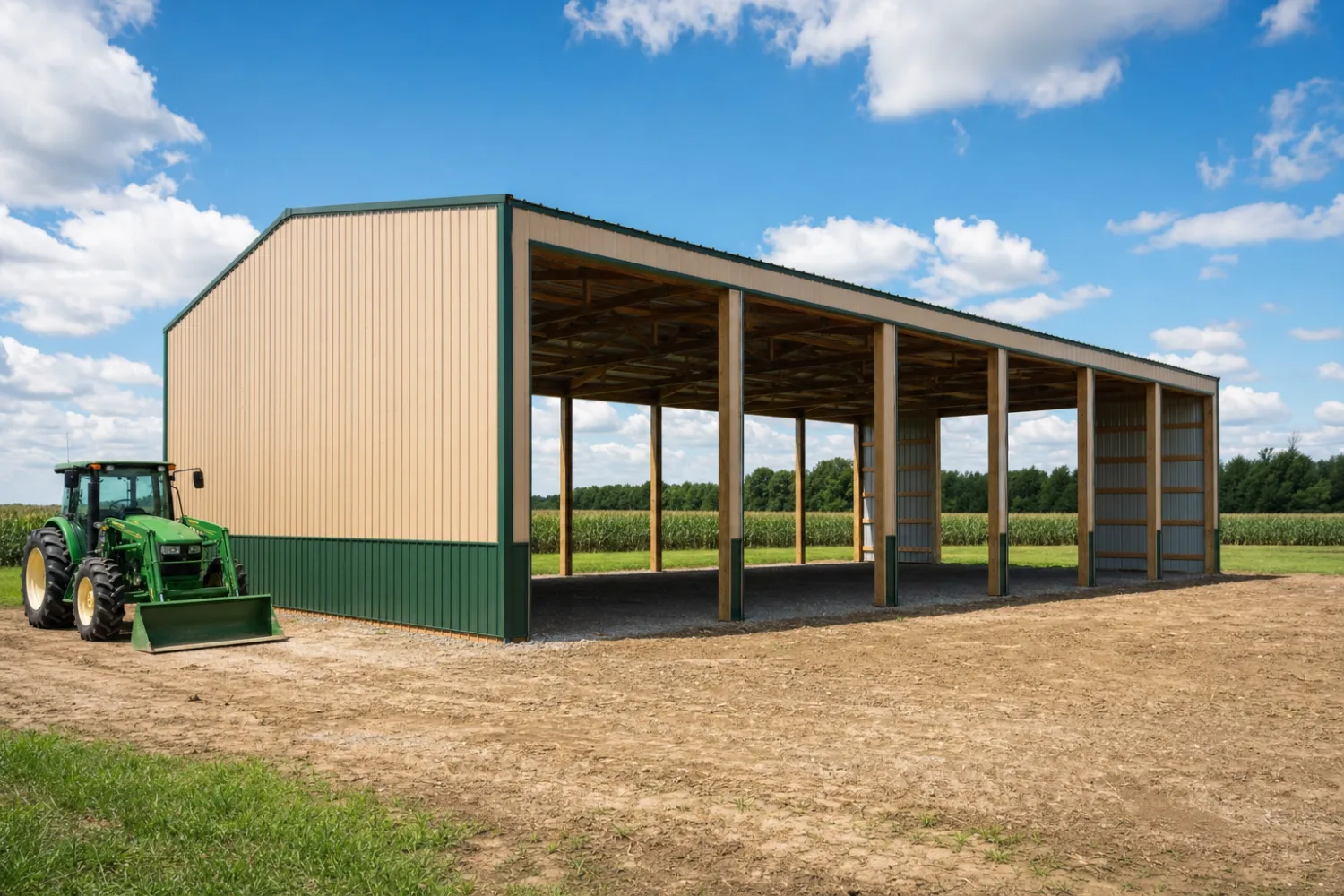
Georgians put steel to work across the map: farm and equipment barns in the south and the agricultural belt, workshops and garages in the suburbs, RV and boat storage near the lakes and the coast, and warehouses along the freight corridors. A barndominium build is common on rural acreage, while metro lots lean toward detached garages and home shops.
Which department you deal with depends on your address, not the state. In the city of Atlanta, permits and zoning run through the city’s Office of Buildings and Office of Zoning and Development at 55 Trinity Avenue SW ‹confirm›. Unincorporated Fulton County builds go through the Fulton County permit office ‹confirm›, and Cobb County runs its own Building Permits and Inspections in Marietta ‹confirm›. Surrounding counties such as DeKalb and Gwinnett each operate separate departments, so confirm the right office for your exact parcel before you apply.
FAQ
Georgia metal building questions
Do you need a permit for a metal building in Georgia?
In most Georgia jurisdictions, yes. Any permanent metal building, and almost anything on a foundation or wired for power, needs a county or city building permit. Some rural counties exempt small accessory structures under a set size, but the threshold varies and zoning setbacks still apply. Confirm with your local building department before you order.
What can I build without a permit in Georgia?
It depends on your jurisdiction. Many counties exempt small accessory structures below a square-foot threshold that are not on a permanent foundation, and minor repairs like re-roofing or residing often need no permit. Bryan County, for example, triggers a permit above 200 square feet or on a permanent foundation. Your county sets its own cutoff, so verify locally.
Does a 20×20 carport need a permit in Georgia?
Almost always. At 400 square feet a carport is well past the small-structure exemption most jurisdictions use, especially with anchored footings or a slab. Setbacks, and any electrical, add their own requirements. Check with your county or city building department before you build.
Do I need stamped engineered drawings in Georgia?
Most Georgia counties require engineer-stamped, sealed drawings for a metal building, prepared or reviewed by a Georgia-licensed professional engineer, so the structure can be checked against local wind and snow loads. Your supplier can usually provide them. Confirm the requirement with your local building department, because the threshold varies by jurisdiction.
What happens if you build a metal building without a permit?
You risk a stop-work order, fines that can run several times the permit fee, forced retrofitting to code, or in the worst case an order to remove the structure. Unpermitted work also complicates insurance claims and the sale or refinance of your property. Permitting first is far cheaper than fixing it later.
Does a metal building increase property taxes in Georgia?
A permanent metal building can raise your assessed value and therefore your property taxes, because it adds improved structure to the parcel. A small structure on a movable, non-permanent base may be treated differently. Your county tax assessor makes the call, so ask locally how your specific build will be valued.
How much does a 40×60 metal building cost in Georgia?
As a rough 2026 guide, a 40×60 building finished with a slab often falls in the high five figures to low six figures once permits, foundation, and local labor are included ‹confirm›, with the bare kit a fraction of that. Coastal wind engineering, site prep, and insulation move the number. Get a written, itemized quote for your county.
Read next
Keep reading
Compare neighboring states and dig into the topics that shape a Georgia build:
- Metal building kits in Florida (coastal wind and the hurricane code next door).
- Metal building kits in Alabama (the Gulf-and-Piedmont neighbor to the west).
- Metal building kits in Tennessee (cooler, more snow in the mountains to the north).
- Metal building kits in South Carolina (a near-identical coastal-wind picture to the east).
- Metal building permits and codes (how approval works step by step).
- Snow load and wind load explained (how loads become steel).
- Metal building foundation options (slabs, piers, and anchorage).
- Metal building insulation (condensation control for a humid climate).
- Metal building kit prices (the cost breakdown pillar).
Sources
Sources
- Georgia Secretary of State, Rule 110-11-1 State Minimum Standard Codes – https://rules.sos.ga.gov/gac/110-11-1
- Georgia Department of Community Affairs, Construction Codes – https://www.dca.ga.gov/safe-affordable-housing/construction-codes-housing-development/construction-codes
- PermitPlace, Georgia Building Codes (statewide mandatory, local enforcement) – https://permitplace.com/state/georgia-building-code/
- Bryan County, GA Building and Codes Division (200 sq ft / permanent-foundation threshold) – https://www.bryancountyga.gov/government/departments-a-g/building-and-codes
- Cobb County, GA Codes, Standards, and Guidelines (metal building systems inspection) – https://www.cobbcounty.gov/community-development/building-development/codes-standards
- City of Atlanta, Office of Zoning and Development & Office of Buildings – https://www.atlantaga.gov/
- Fulton County, GA permit office – https://www.fultoncountyga.gov/
- UpCodes, Georgia Building Codes adoption timeline – https://up.codes/codes/georgia