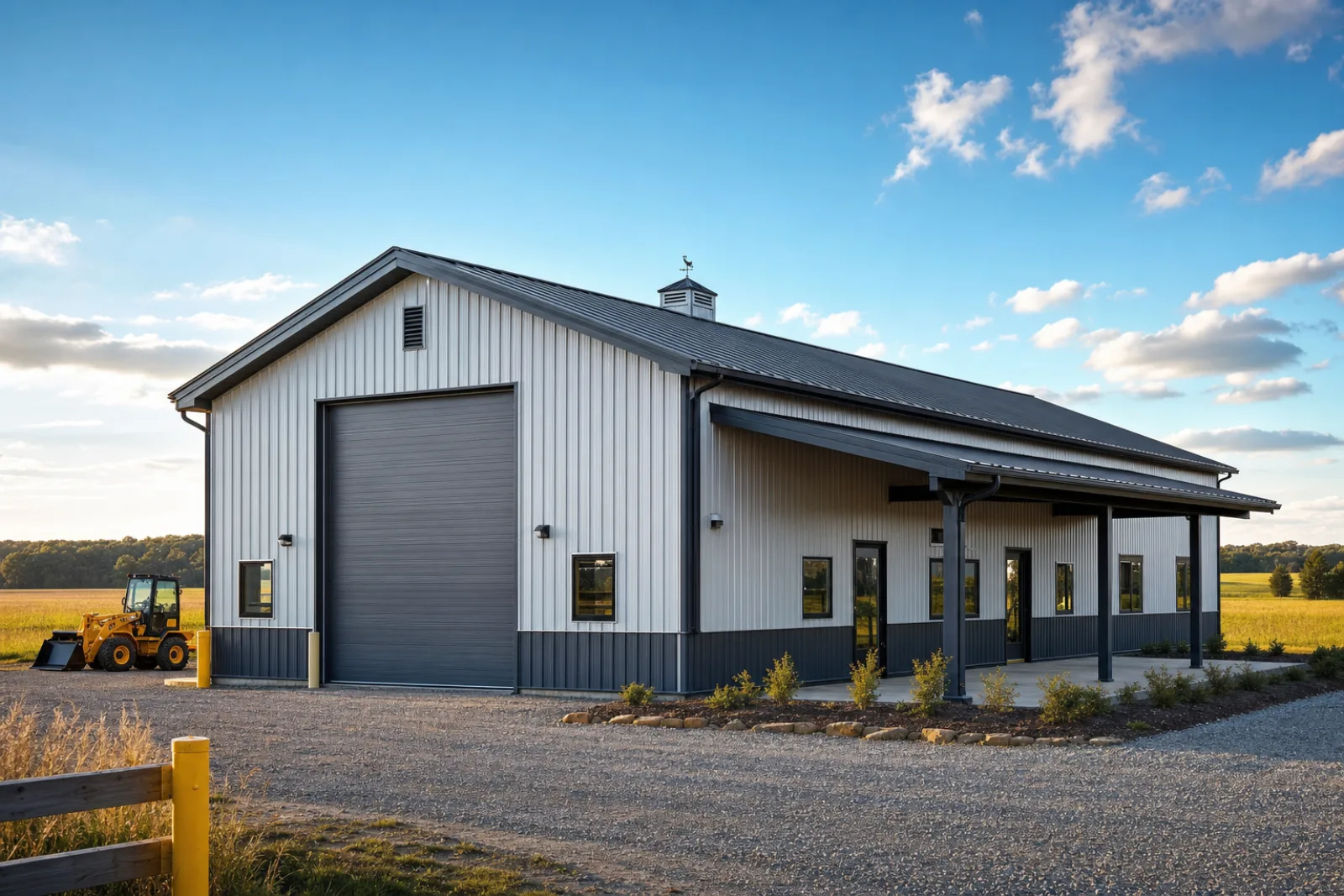
A metal shop building costs roughly $10 to $25 per square foot for the steel shell as a 2026 illustrative range, so a common 30×40 (1,200 sq ft) shop runs about $12,000 to $30,000 for the kit ‹confirm›. Finished and installed, with a slab, doors, and a crew, that same shop usually lands closer to $35,000 to $70,000 ‹confirm›. The shell price buys the red iron frame, the roof and wall panels, the trim, the fasteners, and a stamped drawing set. It does not buy the foundation, the roll-up and walk doors, the wiring, the insulation, the permit, or the labor to raise it, so the finished number always runs above the kit.
This page sits under the metal building kit prices pillar and gives the full price answer that our how much do metal building kits cost guide covers in brief. Below: what a shop shell costs by size, what turns that shell into a finished shop, what moves the number between two quotes, and where you can trim it. Every figure here is a dated 2026 illustrative range to confirm against a live quote, since steel pricing shifts month to month.
By size
How much a shop building costs by size
Shop price tracks footprint first, because you buy the frame and panels by the pound. The sizes below cover the spread most shop buyers ask about, from a one-bay home shop to a wide working garage with room for a lift. These are shell-only, illustrative 2026 ranges. The spread inside each row is real: the low end is a lighter frame on a mild load, and the high end carries heavier red iron, a taller wall for clearance, and stiffer engineering for snow or wind.
| Shop size | Footprint | Shell range (2026, illustrative) |
|---|---|---|
| 24×30 | 720 sq ft, one or two-bay home shop | $9k–$18k ‹confirm› |
| 30×40 | 1,200 sq ft, the common shop pick | $12k–$30k ‹confirm› |
| 40×60 | 2,400 sq ft, large shop with a lift bay | $24k–$55k ‹confirm› |
| 50×80 | 4,000 sq ft, commercial work shop | $45k–$90k ‹confirm› |
Shell only, illustrative for 2026. Foundation, doors, wiring, insulation, permit, and delivery are separate. Confirm against a live quote.
The price per square foot falls as the shop grows, because the fixed cost of the frame and the engineering spreads over more floor. A small home shop can cost more per foot than a building four times its size, even though the larger one costs far more in total. For the per-foot math behind that pattern, see metal building cost per square foot, and for a full chart by dimension, see metal building prices by size.
The full cost
From shell price to a finished shop
A working shop is the shell plus the lines that make it a place you can power, heat, and use. None of them are hidden, since any honest supplier names them when you ask, but they rarely show up in a headline shell price, which is how a shop budget gets blindsided. A shop has its own short list of must-haves the moment you plan to run tools, park a vehicle, or work through winter:
| Cost line | What it is for a shop | Illustrative 2026 range |
|---|---|---|
| Foundation | Slab thick enough for tools, a lift, or a truck | $5–$9 per sq ft ‹confirm› |
| Doors | A roll-up bay door plus a walk door | A few hundred to a few thousand each ‹confirm› |
| Insulation | Keeps a shop workable and cuts condensation | $1–$4 per sq ft by method ‹confirm› |
| Electrical | Sub-panel, outlets, lighting, 240V for tools | A few thousand and up ‹confirm› |
| Permit & engineering | Building permit, plan review, site stamp | A few hundred to a few thousand ‹confirm› |
| Erection labor | A crew to raise the shell, if not DIY | Often 25 to 50 percent of the shell ‹confirm› |
Illustrative 2026 ranges. Every line shifts with region, soil, finish, and crew rates. Confirm each against a local quote.
The foundation is the line shop buyers underestimate most, because a shop slab carries more than a storage floor: a vehicle, a lift, a heavy bench, and the loads they put down. Electrical is the line a storage building skips and a shop cannot, since a real shop needs 240V circuits and bright, even light. For the full breakdown of these add-ons, see the hidden costs of a metal building, and to weigh raising it yourself against a hired crew, see DIY vs installed cost.
Shell price vs finished shop
A “shell” or “kit” price is the steel only. A finished shop adds the slab, the doors, the power, and the labor, and those lines can match or beat the shell on a small building. Always ask which one a number describes. For the per-line method across every size, the metal building cost guide walks the full math.
Read a shop quote for what it includes, not just the number at the bottom. The cheapest total on the page is often the bare shell that left the slab, the doors, and the wiring off the spec sheet.
What moves it
What moves a shop building price
Two shops of the same footprint can price thousands apart, and the spec sheet explains the gap. Before you weigh one quote against another, check the lines that drive the steel number:
- Wall height. Shops want clearance for a door, a lift, or a hoist, and a taller wall adds steel on every column ‹confirm›.
- Frame type. Red iron carries the wide clear span a shop floor wants and costs more than light tube; the frame is the single biggest line on the kit.
- Snow and wind loads. A shop stamped for heavy local loads uses heavier steel, so the same size costs more in snow country than on a mild site ‹confirm›.
- Openings. Each framed bay door, walk door, and window adds trim and engineering to the shell, and a shop usually wants more of them than a storage box.
- Panel gauge and coating. Thicker panels and a longer-lived coating raise the kit price and lower what you spend on upkeep later.
None of these are upsells; they are the spec that makes a shop stand and work where you put it. When you compare two shop prices, line up the wall height, the frame, the gauge, and the load rating first, then the totals. A lower number on a lighter spec is not a better deal. For the factor-by-factor view, see what drives metal building prices. The same steel frames garages, barns, and homes too, so for the broader buying picture start at the metal building kits pillar.
Where to trim
Where you can trim a shop cost
You can lower a shop number without cutting the steel that makes it stand. The savings sit in the finish and the labor, not the frame and the load rating. A few moves keep the structure honest and the price down:
- Raise the shell yourself. Erection labor is the largest add-on, so a bolt-up shell on a small shop is a realistic DIY job that skips it ‹confirm›.
- Insulate and wire in phases. Get the shell dry and the slab poured now, then add power and insulation as the budget allows.
- Pick a standard size. A common footprint like 30×40 prices better than an odd custom span, because the engineering is already proven.
- Keep openings sensible. Every extra door and window adds steel and trim, so frame the bays you need and leave wall for later.
What you should not trim is the frame, the gauge, or the load stamp. Saving on the steel under a wide shop buys interior posts or a building that fails inspection, which costs more than it saves. For the full list of honest savings, see how to save money on a metal building kit.
Related
Read more
This shop price answer connects to the rest of the buying decision. Follow these next:
- Metal building kit prices (the parent pricing pillar).
- Hidden costs of a metal building (the silo guide this page deepens).
- Metal building cost per square foot (the fairest size-to-size compare).
- Metal building prices by size (a chart by dimension).
- DIY vs installed cost (what a crew adds to the shell).
- Metal building cost guide (the full per-line cost reference).
- Metal building uses (the cross-silo pillar for shops and workspaces).