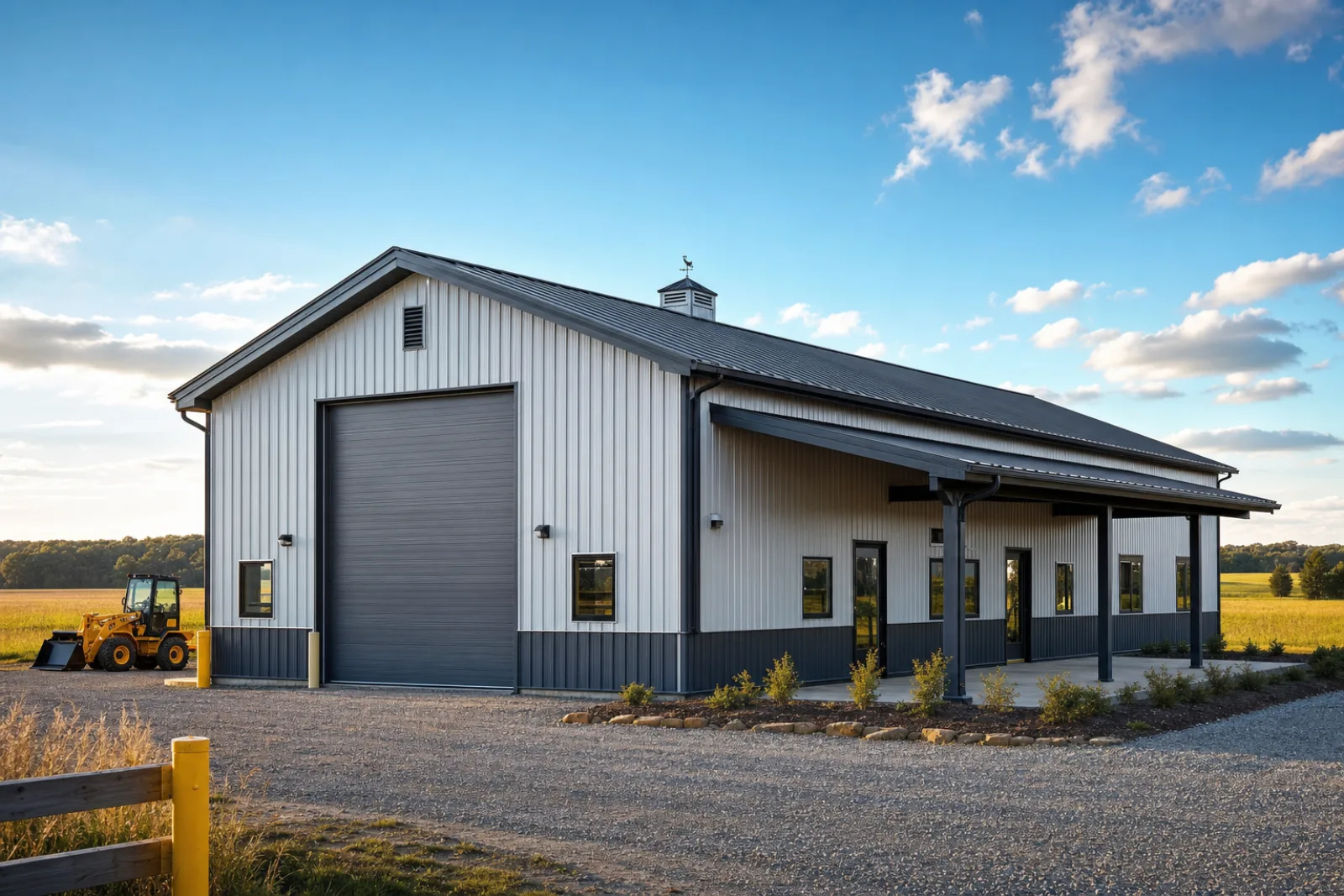
For most metal buildings, 26-gauge steel is the best choice for the roof and wall panels, and 12-gauge is the best choice for a tube frame. That pairing handles everyday snow, wind, and wear across most of the country without paying for steel you will never load. In mild climates and light duty, 29-gauge panels and a 14-gauge frame are enough; in heavy snow or coastal wind, hold the panels at 26 and step the frame up to red iron sized for the span.
The catch is that gauge runs backwards: a lower number means thicker steel, so 26-gauge is heavier than 29, and 12-gauge is heavier than 14. There is no single best number, because panels and frames sit on different scales and your loads pick the winner. This page sits under the metal building kits pillar and gives you the full version: the best panel gauge, the best frame gauge, and how to let your climate and use make the call. For the mechanics behind the scale, start with steel gauge explained.
Panels
The best gauge for roof and wall panels
For roof and wall panels, 26-gauge is the best all-around choice. It is thick enough to resist dents, hail, and the wavy look called oil-canning, and it lies flatter on a long wall than the budget standard. A 29-gauge panel costs less and works on covered walls and mild climates, but it marks and ripples more easily, so it earns its place on light-duty buildings, not on a shop you want to look sharp for decades.
Step up to 24-gauge when you want the thickest skin: standing-seam roofs, hail country, or a finish you want dead flat. The gain over 26 is real but smaller than the jump from 29 to 26, so most owners land on 26 and spend the difference elsewhere. The number alone does not tell the whole story, since much of a panel’s strength comes from its rib profile and how far apart the purlins sit, not the sheet thickness on its own.
| Panel gauge | Best for | What you get |
|---|---|---|
| 29-gauge | Mild climates, covered walls, light duty | Lowest cost; thinnest skin; more prone to denting and oil-canning |
| 26-gauge | Most shops, garages, homes, and barns | The all-around pick; stiffer, flatter, resists dents and hail |
| 24-gauge | Standing-seam roofs, hail country, flat-look walls | Thickest common panel; most impact resistance; highest cost |
A map of panel gauges, not a verdict. The right pick tracks your climate and how the wall earns its keep.
One more point that outranks gauge on the panels: the coating. A well-coated 29-gauge panel can outlast a poorly coated 26, because rust, not thickness, is what ends a panel’s life. Before you chase a heavier gauge, settle the finish in galvanized vs Galvalume vs painted steel, then pick the gauge on top of it.
Frame
The best gauge for the frame
For a tube-steel frame, 12-gauge is the best choice on anything you want to last and load. The walls of a 12-gauge tube are thicker than a 14-gauge tube, so the frame carries more snow, resists more wind, and bends less over the years. A 14-gauge frame is the lighter, cheaper option, and it is the right call on a small open carport with modest loads, where the heavier tube buys reach you will never use.
Frames hit a ceiling, though. Once a building gets wide or has to hold heavy snow, the answer is not a thicker tube but a different frame: hot-rolled red iron, sized by beam shape rather than gauge. Red iron spans wide and clear with no interior posts, which is why shops, barns, and commercial buildings 30 feet and up almost always run it. That choice gets engineered and stamped against your local snow and wind loads, not picked off a gauge chart.
Gauge stops where red iron starts
Gauge only describes tube-steel frames. A red-iron frame is sized by I-beam shape, so a quote that names a frame gauge is quoting tube, and one that says “structural steel” or “I-beam” is quoting red iron. On a wide-span or heavy-snow building, the best frame is not a thicker tube at all; it is red iron stamped for the span.
Match the load
Let your climate and use pick the gauge
The honest answer to which gauge is best comes from your site, not a chart. Spend the gauge where the load lives, and keep the standard gauge where the building is doing light duty. That single habit saves you from the two expensive mistakes: thin steel under real snow, and thick steel on a wall that never sees weather.
- Carport or RV cover. 29-gauge panels and a 14-gauge tube frame are usually enough. Short spans, light loads, low price. See metal garage kits for the lighter end.
- Enclosed garage or workshop. 26-gauge panels and a 12-gauge frame. The upgrade is worth it for the dent resistance and the wind and snow margin.
- Wide-span shop, barn, or commercial. 26-gauge panels on a red-iron frame stamped for your loads. This is not the place to save on the frame.
- Hail or heavy-snow country. Hold panels at 26 or move to 24 on the roof, and let the engineering, not the gauge alone, set the frame.
Cost tracks thickness, so a heavier gauge adds a few hundred to a few thousand dollars ‹confirm› depending on the building size and how much steel changes. That is real money when the load does not call for it, and cheap insurance when it does. Get both numbers, the panel gauge and the frame gauge or beam, written on the quote so you are comparing the same building twice.
Match the gauge to the load, not to the brochure. The thickest steel on a light-duty wall is wasted money, and the thinnest steel under real snow is a failure waiting for winter.
Related
Read more
Which gauge is best connects to the rest of the spec sheet. Follow these next:
- Metal building kits: the complete guide (the parent pillar).
- Steel gauge explained (the full breakdown of the backwards scale).
- Snow load and wind load explained (the loads that decide your gauge).
- Galvanized vs Galvalume vs painted steel (the coating that outranks gauge on panel life).
- How to read a metal building quote (where gauge hides on the price).