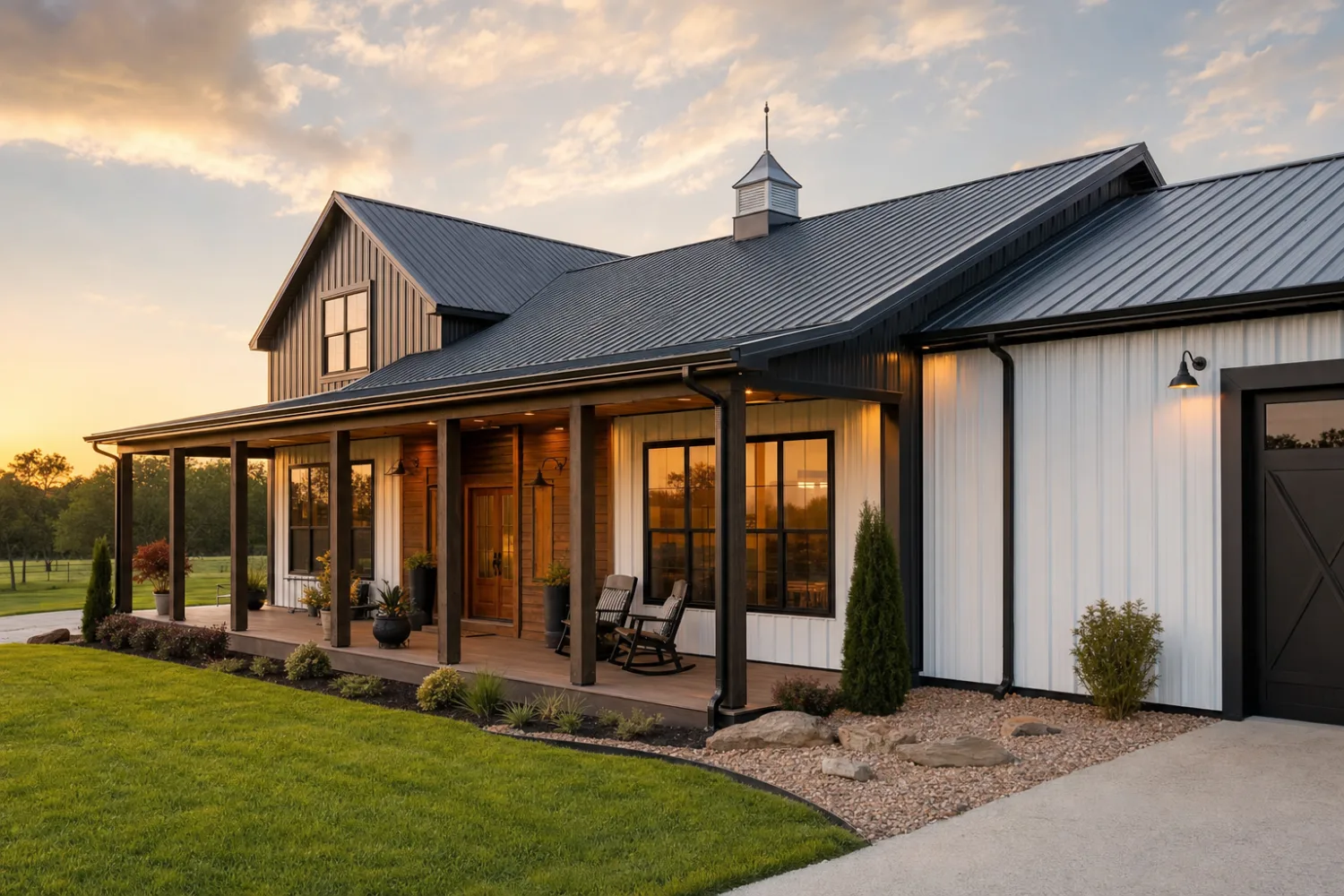
Yes, a barndominium is usually cheaper to build than a comparable traditional home, because a pre-engineered steel shell encloses the space with less material and on-site labor than a stick-framed house. As a dated 2026 illustrative range, a finished barndominium runs about $100 to $200 per square foot ‹confirm›, against roughly $150 to $300 per square foot ‹confirm› for a conventional home of similar size and finish. The saving is widest at the structural shell and narrows once you finish both interiors to the same standard.
This page sits under the metal building homes pillar and gives the full price answer that our metal building homes vs traditional houses guide covers in brief. Below: where the steel saving comes from, why it shrinks as you finish the inside, and what each home costs to own across its life. Every dollar figure here is a 2026 illustrative range to confirm against a live local quote, never a fixed price.
Where it saves
Why a barndominium comes in under a traditional home
A barndominium beats a traditional home on the cost to enclose the building, and the saving traces to three things: a frame engineered and cut as a kit, a bolt-up sequence with no on-site stick framing, and steel that spans a wide great room with no interior load-bearing walls. For the bare structural shell, that kit price is hard for conventional framing to match.
| Stage / finish level | Barndominium ($/sq ft) | Traditional home ($/sq ft) |
|---|---|---|
| Bare steel shell, dried in | $30–$60 ‹confirm› | $55–$95 ‹confirm› |
| Basic finished interior | $80–$130 ‹confirm› | $110–$180 ‹confirm› |
| Full turnkey, equal finish | $100–$200 ‹confirm› | $150–$300 ‹confirm› |
| Wide open great room (40 ft+) | Clears on the steel frame ‹confirm› | Needs beams or load walls ‹confirm› |
Illustrative 2026 ranges to confirm against a live quote. The steel lead is largest at the shell and smallest once both interiors finish alike.
Read the table top to bottom and the pattern shows. The kit lead is largest at the dried-in shell, it holds through a basic interior, and it shrinks as both homes reach the same turnkey finish, since cabinets, flooring, fixtures, and HVAC cost about the same either way. A steel home also skips the rot, warping, and termite risk that a wood frame fights for life. For the per-foot method behind these figures, see what a barndominium costs.
The catch
Why the price gap narrows once you finish the inside
The steel advantage is largest at the bare shell and smallest at the fully finished home, so the headline saving can fade as the interior goes in. Grasp this before you weigh the two on price, because it is where most barndominium-versus-house comparisons go wrong.
On a dried-in shell, a barndominium can land well under a traditional home of the same footprint ‹confirm›, and for an open, rural layout that gap drives the decision. Finish the inside and the math shifts. Drywall, kitchens, baths, flooring, wiring, and HVAC cost roughly the same whether the frame is steel or wood, and a metal home needs furring or interior framing to give those finishes something to attach to. By the time both homes are turnkey, the shell saving is a smaller share of the total ‹confirm›. The interior finishing step is where much of that cost lands.
Price both to the same home
Most barndominium-versus-house arguments fall apart because the two sides price different buildings. A bare steel shell against a finished house is not a fair fight. Decide the finish level first, then quote both methods to that exact standard. For the side-by-side method plus the resale and code differences, see the metal building homes vs traditional houses guide.
Total cost
What each home costs to own over its life
Upfront price is half the comparison; the other half is what each home costs to own across twenty or thirty years, and that is where steel widens its lead again. A coated steel frame does not rot, warp, or feed termites, so it asks for less structural upkeep than a wood-framed home over the decades.
Compare the finished home over its lifespan, not the bare shell on day one. Steel wins the race to weather-tight, and it often wins the decade on maintenance too.
Three long-run lines favor a barndominium. Maintenance runs lower, since the frame does not degrade the way wood can. Insurance can come in lower on a non-combustible steel home than on a wood-framed one ‹confirm›, though that varies by carrier and region, so confirm it with your own insurer. Energy cost depends on how well you insulate, not on the steel itself, so a tight, well-insulated barndominium runs efficient. None of this rules out building traditional: a home with heavy custom detail or a complex roofline can be simpler to frame in wood, and lenders know that path well. Financing is its own variable, so weigh the financing options for a metal home before you commit. For the cross-silo cost method behind kit pricing, see the metal building kit prices pillar.
Related
Read more
This price answer connects to the rest of the barndominium decision. Follow these next:
- Metal building homes: the complete guide (the parent pillar).
- Metal building homes vs traditional houses (the full method comparison this page deepens).
- What a barndominium costs (the full cost breakdown by stage).
- Drywall and interior finishing options (the finish step that closes the price gap).
- Financing a barndominium or metal home (loans, appraisals, and lender comfort).