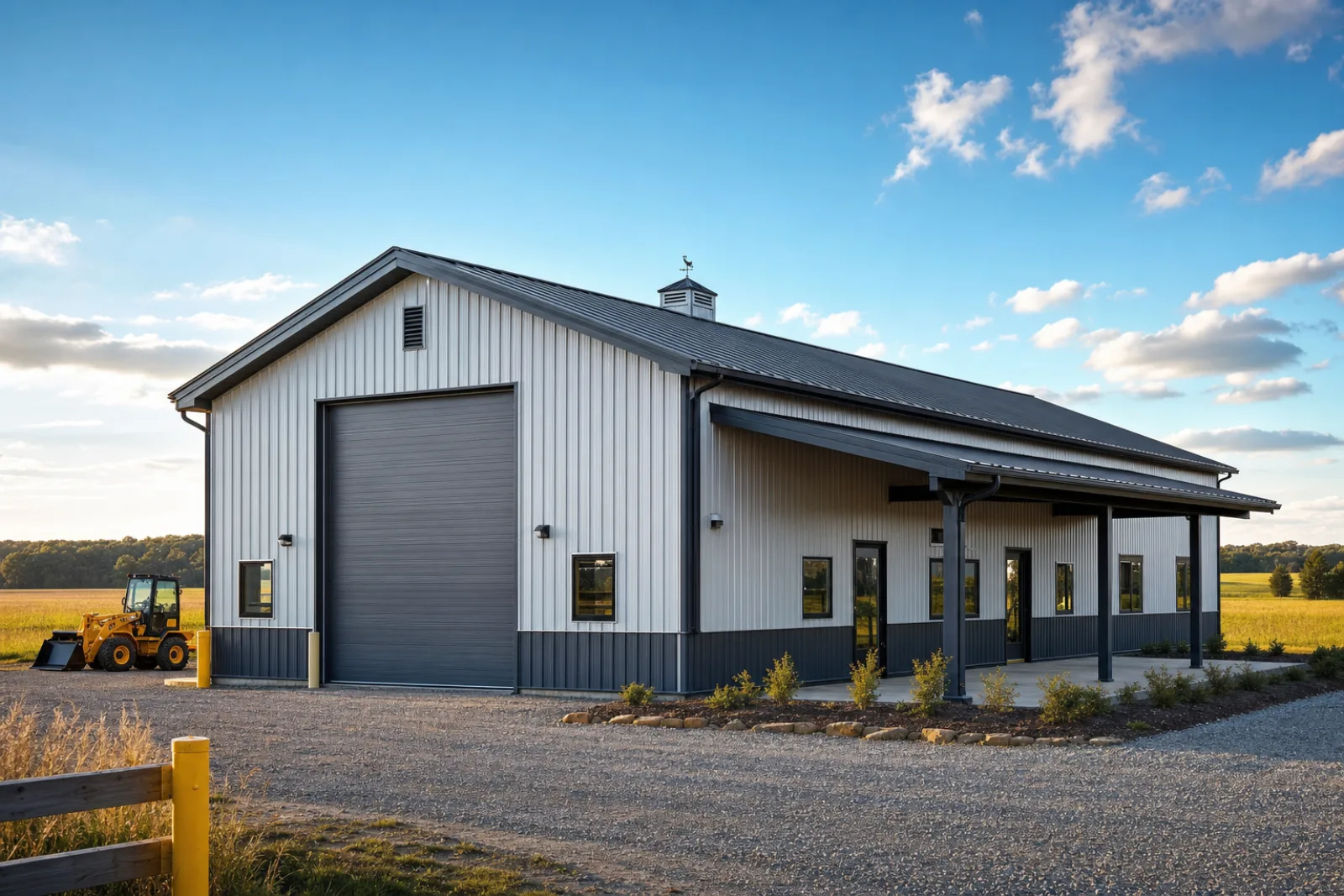
A metal garage kit costs roughly $4,000 to $42,000 for the steel shell as a 2026 illustrative range, with most buyers landing near $8,000 to $16,000 for a standard two-car size ‹confirm›. That number buys the frame, the roof and wall panels, the fasteners, the trim, and a stamped drawing set. It does not buy the concrete slab, the doors, the insulation, the permit, or the delivery, so the finished garage always costs more than the kit.
This page sits under the metal garage kits pillar and gives the full price answer that our metal garage kit prices guide covers in brief. Below: what a kit price includes, what it costs by size, and the lines that turn a shell price into a finished cost. Every dollar figure here is a dated 2026 illustrative range to confirm against a live quote, since steel pricing moves month to month.
The shell price
What a metal garage kit price covers
A kit price is the steel shell, not the finished garage. The shell is the frame, the roof and wall panels, the fasteners and trim, and the engineered drawings stamped for your site. That is the figure you see advertised, and it is the honest place a budget starts. What it leaves out is everything that turns a stack of steel into a garage you can lock, park in, and heat.
Split the cost into two buckets and the budget stays honest. The first bucket is the kit. The second is the site work and finish that stand it up. When one supplier quotes a far lower number than another for the same footprint, the cheap one is usually a bare shell and the dear one is closer to a finished, installed price. The frame and panel gauge drive most of the shell number, so read what each quote includes before you weigh two totals against each other.
By size
How much a metal garage kit costs by size
Shell price tracks footprint more than anything else, because you buy steel by the pound. The sizes below cover what most buyers ask about, from a single bay to an RV-height garage. These are shell-only, illustrative 2026 ranges, and the spread inside each row is real: the low end is a light tube frame on a mild load, and the high end carries heavier framing, thicker panels, a taller wall, and stiffer engineering.
| Size | Common use | Shell range (2026, illustrative) |
|---|---|---|
| 1-car (12×20 to 14×24) | One vehicle plus some gear | $4k–$9k ‹confirm› |
| 2-car (20×20 to 24×24) | The common residential pick | $8k–$16k ‹confirm› |
| 3-car (24×30 to 30×30) | Two vehicles plus a workshop | $14k–$26k ‹confirm› |
| 4-car or RV (30×40, tall door) | Multiple bays, boat, or RV | $24k–$42k ‹confirm› |
Shell only, illustrative for 2026. Slab, doors, insulation, permit, and delivery are separate. Confirm against a live quote.
Notice the price per square foot falls as the garage grows, because the fixed cost of the frame and the engineering spreads over more floor. A small single-car kit can cost more per foot than a four-car building, even though the four-car costs far more in total. Match the footprint to what you park and store: see the one-car, two-car, and three and four-car guides for the size that fits.
The full cost
From shell price to finished cost
The finished cost is the shell plus the lines that make it a usable garage. None of them are hidden, since any honest supplier names them when you ask, but they rarely show up in a headline price, which is how a budget gets blindsided. Add each one to the steel before you call any number your total. The list below is the stack that sits on top of the kit:
| Cost line | What it is | Illustrative 2026 range |
|---|---|---|
| Foundation | Slab, anchor bolts, grading | $4–$8 per sq ft ‹confirm› |
| Doors | Roll-up and walk doors, framed openings | Hundreds to a few thousand each ‹confirm› |
| Insulation | Vapor barrier, batt, or spray foam | $1–$4 per sq ft by method ‹confirm› |
| Permit & engineering | Building permit, plan review, site stamp | A few hundred to a few thousand ‹confirm› |
| Delivery / freight | Trucking the steel from the plant | Hundreds to a few thousand by distance ‹confirm› |
| Erection labor | A crew to raise the shell, if not DIY | Often 25 to 50 percent of the shell ‹confirm› |
Illustrative 2026 ranges. Every line shifts with region, soil, finish, and crew rates. Confirm each against a local quote.
The foundation is the line buyers underestimate most, since soil, slope, and finish all move it, and a garage stamped for heavy loads needs a slab to match. Erection labor is the largest single add-on, which is why a small garage is a realistic DIY job that skips it. If you plan to heat or work in the space, weigh the insulated garage path before you finish the walls, because adding it later costs more.
Shell price vs turnkey price
A “shell” or “kit” price is the steel only. A “turnkey” price is the finished, installed garage. The two can sit thousands apart for the same footprint, so always ask which one a number describes. For the per-line math and the cross-silo cost method, see the metal building kit prices pillar.
Read a quote for what it includes, not just the number at the bottom. The cheapest total on the page is often the one that left the most off the spec sheet.
Related
Read more
This price answer connects to the rest of the garage buying decision. Follow these next:
- Metal garage kits: the complete guide (the parent pillar).
- Metal garage kit prices (the full cost breakdown this page deepens).
- 2-car metal garage kits (the most-quoted size).
- 3-car & 4-car metal garage kits (where workshops and RVs fit).
- Insulated metal garage kits (the cost of a heated, finished space).
- Metal building kit prices (the cross-silo cost pillar).